
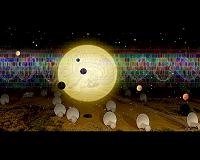
The Search for Extraterrestrial Intelligence (SETI) has gone on for decades without hearing ET call. SETI has mostly been performed with radio telescopes. That's understandable. Humans use radio for telecommunications, so much that our own radio transmissions are percolating through interstellar space.
In recent decades, lasers and photonics have also become important, and the world is covered in fibreoptic cables. This type of communication is hard to detect from deep space, but we are now using lasers to communicate with spacecraft as far away as the Moon. It doesn't take much to suggest that lasers will soon be used more often, and at greater distances. In turn, SETI has also carried out experiments in trying to detect laser pulses from alien civilizations.
Astronomers have also searched for macro-artefacts around other star systems, including the much-discussed concept of "Dyson Spheres" that would enclose entire solar systems.
That's a lot of search. But so far, we have found nothing.
A recent paper by the research group METI International poses a potential solution to this dilemma. Have we been searching for the wrong type of signals? (http://meti.org/blog/does-et-talk-zeta-rays)
SETI practitioners have long wondered if more advanced forms of communications are being used by extraterrestrials, but haven't been able to search for them.
Despite its high profile, SETI is really an under-funded science. It generally piggybacks on radio telescopes that are built and mostly used for other purposes. It's hard enough to search for radio signals and laser pulses. So far, looking for anything more exotic hasn't been possible.
Science fiction writers and visionaries have speculated on advanced communications systems that don't exist today, at least for us. Can we use neutrinos to beam signals? Or can we even consider sending messages that travel faster than light? SETI practitioners like to joke about "Zeta Rays", which represent some form of unknown physical phenomenon used by aliens. But could Zeta Rays be real?
Nobody will suggest that our knowledge of physics is complete. We struggle to explain some phenomena that we already know. What of the things that we don't know about at all?
Until we know more, the search for extraterrestrials will continue. But we will also search for new ways to communicate.
New Collaboration with Jodrell Bank Observatory for SETI
Breakthrough Initiatives and the Jodrell Bank Centre for Astrophysics at the University of Manchester announced a new partnership to search for evidence of intelligent life beyond Earth.
Breakthrough Listen, the most comprehensive scientific search for intelligent life ever launched, will share information with Jodrell Bank's team, who wish to conduct an independent SETI search via its 76- … read more
