
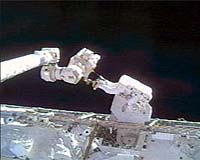
Discovery astronauts Piers Sellers and Mike Fossum completed both major objectives during a six-hour, 47-minute spacewalk Monday, their second such excursion since they arrived at the International Space Station last Thursday.
Their first task was installing a spare thermal-control system pump on to the outside of the Quest Airlock. Then, Sellers and Fossum replaced a reel assembly for a cable that provides power and data to the station's mobile transporter.
Completion of that task returned full function to the transporter's primary and backup systems for future station-assembly tasks.
Discovery pilot Mark Kelly coordinated the spacewalk activities from inside the shuttle, and commander Steve Lindsey monitored vehicle systems and video setups. Mission specialists Stephanie Wilson and Lisa Nowak took turns operating the robotic arm as necessary.
Sellers and Fossum completed the spacewalk at 3:01 p.m. Eastern Time.
During their first spacewalk on Saturday, Sellers and Fossum tested the strength and stability of a boom extension on the shuttle's robotic arm, in case the boom would need to be used as a work platform in the future.
While the shuttle crew focused on the spacewalk, the space station crew of Pavel Vindogradov and Jeffrey Williams loaded the Leonardo multi-purpose logistics module with scientific experiment results, unneeded items and trash from the station. Leonardo will return to Discovery's payload bay Friday in preparation for the return to Earth.
The final scheduled spacewalk, which will test on-orbit shuttle heat-shield repair techniques, is scheduled to begin at 7:13 a.m. Eastern Time on Wednesday.
During that excursion, technicians at NASA's Langley Research Center in Virginia will be watching as Sellers and Fossum demonstrate a space-hardened, heat-sensing camera as part of NASA efforts to detect and repair damage to the leading edges of the shuttle's wings.
The leading edge material is made of reinforced carbon-carbon – a tough composite material – that is laminated like a sheet of plywood. Features on the surface may or may not indicate the level of damage to underlying layers.
The infrared camera can sense differences in heat radiated from the leading edge surface that could indicate irregularities beneath. The technology has proven highly effective in lab tests, and technicians hope that it will work equally well in the space environment.
The camera is scheduled to be demonstrated on several panels of the forward edge of the wing, to measure heating rates where no damage is expected to be detected, and on material samples in a test rig in the open payload bay. The samples have both surface and subsurface impact damage that has been characterized in the lab.
