
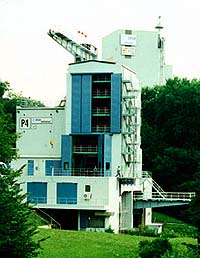
It is literally full steam ahead at the P4 rocket engine test stand at the German Aerospace Research center (DLR) in Lampolshausen, Germany. It is here that the upper stage engines of launchers and the engines used to place satellites and space probes into the correct orbit are tested.
These engines have to ignite in space, more than 120 km above the Earth, where the atmosphere is virtually non-existent. In order to test upper stage engines DLR have constructed special test stands to recreate, as near as possible, the conditions found in space. DLR has two test facilities: P4.1 and P4.2.
P4.1 test stand
This was originally used for testing under sea level conditions and for testing the Ariane-4 liquid strap-on boosters. Now it is being transformed to test Vinci, the cryogenic upper-stage engine of the new Ariane 5 ESC-B launcher. Once in use this will be the most powerful of the Ariane launchers and will be capable of putting dual payloads of up to 12 tonnes into orbit.
In order to test the Vinci engine the P4.1 facilities have been enlarged to accommodate the systems needed to carry out cryogenic tests, these include a vacuum test cell for the new engine. The steam ejector system has also been enlarged to cope with testing this powerful engine.
The first Vinci engine tests are planned for the end of 2002. Once these are completed P4.1 will again be modified to accommodate the entire cryogenic upper stage of ESC-B, which is scheduled to come into operation at the end of 2005.
P4.2 test stand
