
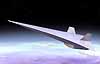
A revolutionary design for a hypersonic aircraft that could fly between any two points on the globe in less than two hours has been developed by a researcher at the U.S. Department of Energy's Lawrence Livermore National Laboratory.
Dubbed HyperSoar — the design was featured in the Sept 7 issue of Aviation Week & Space Technology. HyperSoar could fly at approximately 6,700 mph (Mach 10), while carrying roughly twice the payload of subsonic aircraft of the same takeoff weight.
The HyperSoar concept promises less heat build-up on the airframe than
previous hypersonic designs — a challenge that has until now limited the
development of hypersonic aircraft.
Skipping Over The Atmosphere
The key to HyperSoar is the skipping motion of its flight along the edge of Earth's atmosphere — much like a rock skipped across water. A HyperSoar aircraft would ascend to approximately 130,000 feet — lofting outside the Earth's atmosphere — then turn off its engines and coast back to the surface of the atmosphere. There, it would again fire its air-breathing engines and skip back into space. The craft would repeat this process until it reached its destination.
A commercial flight from the midwestern United States to Japan would require approximately 25 such skips to complete the one-and-a-half-hour journey. The aircraft's angles of descent and ascent during the skips would only be 5 degrees. Passengers would feel 1.5 times the force of gravity at the bottom of each skip and weightlessness while in space. (1.5 Gs is comparable to the effect felt on a child's swing, though HyperSoar's motion would be 100 times slower.)
"We believe we have developed a design that not only addresses the primary
issues in building hypersonic aircraft, but does so in a way that creates a number of different uses for HyperSoar, thereby helping offset its
development costs," said Livermore aerospace engineer Preston Carter,
developer of the HyperSoar concept.
"An aircraft with the speed, range and lift of HyperSoar could revolutionize intercontinental flight and access to space."
Potential applications for HyperSoar aircraft are varied:
Passenger aircraft — A commercial HyperSoar airliner or business jet could reach any destination on the planet from the continental U.S. in
two hours or less.
Freighter — A HyperSoar freight aircraft could make four or more
roundtrips to, say, Tokyo each day from the U.S. versus one or less for
today's aircraft. Analysis indicates a HyperSoar aircraft flying
express mail between Los Angeles and Tokyo could generate ten times the
daily revenue of a similarly- sized subsonic cargo plane of today.
Military aircraft — A HyperSoar bomber the size of a B-52 could take
off from the U.S. and deliver its payload to any point on the globe —
from an altitude and at a speed that defies all current defensive
measures — and return to the U.S. without the need for refueling or
forward bases on foreign soil. Equipment and personnel could also be
transported.
Space lift — HyperSoar could be employed as the first stage of a
two-stage-to-orbit space launch system. Research shows this approach
will allow approximately twice the payload-to-orbit as today's
expendable launch systems for a given gross takeoff weight.
HyperSoar Advantages
Most current hypersonic designs rely on rocket engines to boost the aircraft
to the edge of space, from where the craft essentially glides back down to
its destination. Other designs simply use engines to push the aircraft
through the atmosphere.
All previous concepts have suffered from heat buildup on the surface of the
aircraft and in various aircraft components due to friction with the
atmosphere.
A HyperSoar plane would experience less heating because it would spend much
of its flight out of the Earth's atmosphere. Also, any heat the craft picked
up while "skipping" down into the atmosphere could be at least partially
dissipated during the aircraft's time in the cold of space.
Another HyperSoar advantage is its use of air-breathing engines. Most
conventional hypersonic designs rely on rocket motors to boost the aircraft
to the edge of space. By not boosting to as high a velocity, and by dropping
back into the atmosphere at the bottom of each "skip," a HyperSoar plane can
utilize air-breathing engines, which are inherently more efficient than
rocket engines. Also, HyperSoar engines would be used strictly as
accelerators, rather than as accelerators and cruising engines — as in some
hypersonic designs — thereby greatly simplifying the design and reducing
technical risk.
Although the porpoising effect of a HyperSoar flight might test the
adventurousness of some airline passengers, the Lab's Carter does not see
this impacting business travel or military or space launch applications,
and, in fact, he believes commercial fliers would eventually take to the
concept, as well.
"The average passenger will probably put up with the slight roller coaster
motion if it gets them from San Francisco to Tokyo in less than two hours,
rather than ten-and-a-half," said Carter.
The HyperSoar concept has been under investigation by Lawrence Livermore for
several years and is being discussed with the U.S. Air Force and other
government agencies. Livermore has been working with the University of
Maryland's Department of Aerospace Engineering to refine the aerodynamic and
trajectory technologies associated with the concept.
Carter estimates that approximately $140 million would need to be spent over
the next few years to advance several technologies to the point where a $350
million one-third-scale flyable prototype could be built and tested. Carter
estimates the development cost of full-scaled HyperSoar aircraft to be about
the same as spent to develop the Boeing Company's new 777.
DOE's Lawrence Livermore National Laboratory is managed by the University of
California.
