
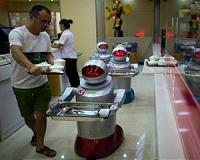
Robots have a lot to learn about humans, including how to respect their personal space. Scientists at the Institute of Automatics of the National University of San Juan in Argentina are giving mobile robots a crash course in avoiding collisions with humans.
The researchers published their methods in IEEE/CAA Journal of Automatica Sinica (JAS), a joint publication of the IEEE and Chinese Association of Automation.
"Humans respect social zones during different kind[s] of interactions," wrote Daniel Herrera, a postdoctoral researcher at the Institute of Automatics of the National University of San Juan and an author on the study. He notes how the specifics of a task and situation, as well as cultural expectations and personal preferences, influence the distance of social zones.
"When a robot follows a human as part of a formation, it is supposed that it must also respect these social zones to improve its social acceptance."
Using impedance control, the researchers aimed to regulate the social dynamics between the robot's movements and the interactions of the robot's environment. They did this by first analyzing how a human leader and a human follower interact on a set track with well-defined borders.
The feedback humans use to adjust their behaviors – letting someone know they're following too closely, for example – was marked as social forces and treated as defined physical fields.
The human interactions (leading and following), including the estimated social forces, were fed to a mobile robot. The programmed robot then followed the human within the same defined borders, but without impeding on the social forces defined by the human interactions.
"Under the hypothesis that moving like human will be acceptable by humans, it is believed that the proposed control improves the social acceptance of the robot for this kind of interaction," wrote Herrera.
The researchers posit that robots are more likely to be accepted if they can be programmed to respect and respond like humans in social interactions. In this experiment, the robot mimicked the following human, and avoided the leader's personal space.
"The results show that the robot is capable of emulating the previously identified impedance and, consequently, it is believed that the proposed control can improve the social acceptance by being able to imitate this human-human dynamic behavior."
Lockheed Martin and NEC to Enhance Satellites, Space Travel with Artificial Intelligence
Lockheed Martin and NEC Corp have announced that Lockheed Martin will use NEC's System Invariant Analysis Technology (SIAT) in the space domain. SIAT's advanced analytics engine uses data collected from sensors to learn the behavior of systems, including computer systems, power plants, factories and buildings, enabling the system itself to automatically detect inconsistencies and prescribe resol … read more
