
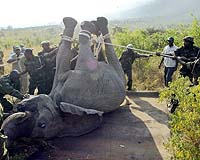
Drought has forced Kenyan wildlife authorities to indefinitely put off the resumption of a massive elephant transfer billed as "the single largest translocation of animals ever undertaken since Noah's Ark," officials said Tuesday.
The Kenya Wildlife Service (KWS) had planned this month to resume the relocation of 400 jumbos from an overcrowded coastal reserve to a more spacious inland national park after it suspended the operation in September, expecting that rains would hamper the move.
But the November and December short rains never came, putting millions of humans, livestock and wildlife at risk around the country and forcing the KWS to cancel the restart of the operation, officials said.
"Due to the current drought, we cannot resume the relocation of elephants," KWS spokeswoman Connie Maina told AFP.
The relocation had begun with great fanfare and international media coverage in late August when the first of the elephants was moved from the Shimba Hills National Reserve near Kenya's Indian Ocean coast to the Tsavo East National Park.
But it was suspended less than a month later after only 150 elephants had been moved amid concerns the short rains could pose logistical problems.
Now, the drought has caused a severe deterioration in the habitat at Tsavo, causing increasing human-wildlife conflict in the area, and Maina said KWS would only resume the operation when the rains begin again.
"There is more vegetation in Shimba Hills than there is in Tsavo," she said. "We shall resume only after the rains resume and enough vegetation grows."
Last week, KWS said conditions in several of the country's best-known parks and reserves were such that animals, mainly elephants, were increasingly coming into conflict with residents of nearby villages and farms as they stray from sanctuaries in search of food and water.
Tsavo has been a hotbed of such conflicts and at least two villagers have been killed by elephants this month, according to park officials.
The 3.3-million-dollar (2.6-million-euro) relocation was aimed at reducing the elephant population from the 192-square kilometer (74-square mile) Shimba Hills to the much larger 13,747-square kilometer (5,307-square mile) Tsavo East, where their numbers were decimated by poachers in 1970s and 80s.
