
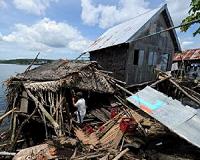
Eight people were killed and dozens injured when a series of earthquakes struck islands in the far northern Philippines early Saturday, toppling historic buildings and sending terrified locals fleeing their homes.
The tremors hit the province of Batanes, a group of sparsely populated islets north of the nation's largest Luzon island, tearing deep cracks in roads and forcing the evacuation of a hospital.
Authorities said some of the dead, including two babies under a year old, were crushed by the walls of their own homes.
"We saw houses shaking. Some of the walls of the houses collapsed and fell on the victims," Police sergeant Uzi Villa told AFP.
"Some people died because they were sleeping soundly since it was still early," he added.
Many people were still asleep when the first tremor struck around 4:15 am (2015 GMT Friday), followed just under four hours later by a second, stronger jolt.
The biggest of the quakes — of magnitude 5.4 and 5.9 — struck within hours of each other, according to the US Geological Survey.
At least three aftershocks followed, which prompted edgy locals to spend hours in town squares waiting for the string of quakes to end.
Authorities said two people were reported missing, though they have not completed a search of the area because debris was blocking some roads.
Raul de Sagon, mayor of worst-hit Itbayat town, told AFP that eight people had been killed and around 100 others were hurt, including seven serious cases that had to be flown out.
Itbayat's hospital was damaged and patients had to be wheeled to safety, while at least one high school and the area's 19th-century church were heavily damaged.
Batanes is pounded every year by tropical cyclones and typhoons that blast through the Philippines and homes are built of stone to survive the annual onslaught.
"We always experience typhoons so houses here are made to withstand strong winds," de Sagon said. "But we were not prepared for earthquakes such as this."
The Philippines is part of the Pacific "Ring of Fire", an arc of intense seismic activity that stretches from quake-prone Japan through Southeast Asia and across the Pacific basin.
The country's most recent deadly quake occurred in April when at least 11 people were killed and a supermarket collapsed in a 6.3-magnitude tremor that hit a region north of the capital Manila.
Earthquake shakes Athens
Athens (AFP) July 28, 2019 –
An earthquake jolted Athens on Sunday although there were no immediate reports of damage or injuries.
According to early reports from the Greek Geodynamic Institute, the 4.2-magnitude quake's epicentre was 23 kilometres (14 miles) northwest of Athens.
It is believed to have been an aftershock of the strong tremor that hit the city on July 19, knocking out phone and cellphone service.
According to the institute, that tremor was a 5.1-magnitude quake with an epicentre 23 kilometres (14 miles) northwest of the Greek capital.
There is "no reason for concern. It is a normal aftershock of the 5.1 quake," the institute's director Akis Tselentis told Athens News Agency.
Scientists had said they were expecting an 4.0-magnitude aftershock.
Greece lies on major fault lines and is regularly hit by earthquakes, but they rarely cause casualties.
In 2017, a 6.7-magnitude earthquake killed two people on the island of Kos in the Aegean sea, causing significant damage.
In 1999, a 5.9-magnitude quake left 143 people dead in Athens and the region northwest of the capital.
