
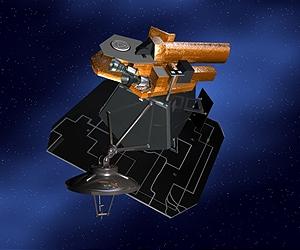
As we approach the anniversary of the EPOXI flyby of Hartley 2, it is time to look at what we have learned about comets from this mission. In the first week of October, a special session of the annual DPS meeting, jointly held with the European Planetary Science Congress, highlighted recent mission results in an all-day session
Key results from EPOXI included:
+ new evidence that the two lobes of Hartley 2 are different in composition,
+ separation of the icy grains from the refractory grains quantitatively improved statistics on the motion of the large chunks in the coma,
+ the correlation of surface ice with topography on the nucleus,
+ an analysis of spectra showing that the thermal inertia of the nucleus is very small (highest surface temperature at noon rather than in the afternoon).
The results for the abundances of carbon monoxide (CO) and carbon dioxide (CO_2 ) relative to water mesh nicely with results from the Akari satellite on these abundances in other comets and the results on deuterium in Hartley 2 suggest that the origin of comets needs to be rethought.
Meanwhile, NASA has decided that there will be a senior review of all operating planetary exploration missions. That will likely include a review of the status of the Deep Impact Flyby spacecraft to determine whether an additional extended mission should be approved. Decisions will not occur until early 2012.
EPOXI Mission Status Report Michael A'Hearn October 20, 2011
The spacecraft went through a cool-down period at the end of September to optimize the capabilities of the near-IR spectrometer and to carry out a Trajectory Correction Maneuver (TCM). This maneuver changed our target point based on our improved knowledge of the position of the comet relative to the spacecraft.
We think that the new target point will be within 100-200 km of the desired flyby point (which is 700 km from the nucleus). We expect our next and final TCM to be on October 27. We have a contingency plan for a TCM on November 2 in case the previous TCM does not perform as expected.
We have been receiving Hartley 2 data from a variety of other spacecraft and collaborators. The WISE mission released data acquired in May. Those data will be useful in understanding the onset of activity by the comet as it approaches the sun in its orbit.
Weaver et al. released
Hubble Space Telescope images acquired on September 25. The HST images are particularly valuable because they allowed us to confirm that the cometary nucleus is separable from the coma.
Eventually, we will be able to separate the nucleus from the coma within our own data. For now, HST has a huge advantage over our own cameras in this respect due to the much larger aperture of HST coupled with the fact that Earth and HST were much closer to the comet than was our spacecraft. These data are consistent with earlier determinations of the size of the nucleus.
We have also been receiving widespread reports of jets in the coma of the comet. The first such report was from Matthew Knight and colleagues at Lowell Observatory who found jets in the gas (the unstable radical CN) but not in the dust during an August observing run . Since then, we have had more recent reports of jets from both professional and amateur observers.
Since the Deep Impact spacecraft has its cameras dedicated to monitoring Hartley 2 during this phase of the mission, we now have an advantage over other observatories and telescopes because we have nearly continuous coverage (16 out of every 24 hours).
We too see fluctuations and jet-like structures in our data that are presumed to be due to variations in the release of dust and gas as the nucleus rotates. More excitingly, we have discovered a new cometary phenomenon!
In September, outgassing from CN, as detected by the MRI, increased slowly by a factor of 5 and then slowly decreased while the dust showed no dramatic change. This activity took place over the course of 16 days.
We are unaware of any other instances of this type of activity in any other comets and it is very different from the dust outbursts observed with the same instrument at Tempel 1.
