
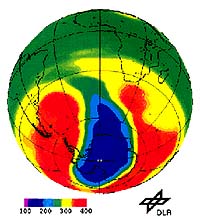
The continued monitoring of ozone is assured well towards the end of the next decade through a 38.3 million Euro contract signed last week in Florence, Italy for three new Global Ozone Monitoring Experiment (GOME-2) instruments.
GOME-2 is an enhancement of the ESA GOME-1 instrument flown on ERS-2, the Earth Observation satellite, which to date continues to provide a wealth of scientific data from orbit.
Within the EUMETSAT Polar System, which consists of a space segment comprised of three METOP satellites and their payloads, and a ground segment for command, control and data processing, GOME-2 is the operational instrument specifically devoted to measuring the ozone content in the atmosphere.
GOME-2 measurements will allow the daily global retrieval of total ozone and vertical ozone profile in the atmospheric, and in addition, the measurement of atmospheric trace gases.
The EUMETSAT Polar System, and the ESA METOP-1 Programme together form a co-operative venture between the two organisations, and lead to the launch of the first METOP satellite in mid-2003. The system provides operational meteorological data from polar orbiting satellites, to complement and complete an international system of polar satellites operated together with the US.
The contract on the procurement of three flight models of the GOME-2 instrument was signed today by Dr. Claudio Mastracci, ESA Director of Applications Programmes, Dr. Tillmann Mohr, EUMETSAT Director, and Dr. Giancarlo Grasso, Deputy Head, Defence Sector of Finmeccanica for Alenia Difesa/Officine Galileo BU Spazio.
The variations of atmospheric ozone are of vital importance for many reasons, and its distribution in the atmosphere needs to be mapped continuously. The enhanced GOME-2 instrument on METOP will continue the series of ESA measurements started by GOME-1 on ERS-2 and to be provided by the SCIAMACHY instrument on ESA's environmental satellite Envisat due to be launched in 2001.
In addition to innovative data for Numerical Weather Prediction, one of the most important contributions of GOME-2 will be the continuation and improvement of the climate record of ozone. Monthly and seasonal maps of ozone distribution throughout the atmosphere will provide a record of its variation with time and will help detect long-term trends of major importance for the health of the planet and its population.
The GOME-2 Instrument
