
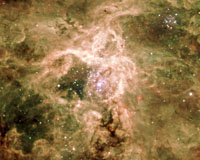
Hanging above the nearly Large Magellanic Cloud – a miniature galaxy and one of the Milky Way's closest neighbors – is the Tarantula nebula. Also designated 30 Doradus or NGC 2070, the nebula owes its name to the arrangement of its brightest patches of nebulosity that somewhat resemble the legs of a spider.
The name of one of the biggest spiders on Earth fits the nebula, because of its gigantic proportions – measuring nearly 1,000 light-years across.
Tarantula also is the largest radio-emissions nebula in the sky, and constitutes one of the largest known star-forming regions in all the Milky Way's neighboring galaxies. Located about 170,000 light-years away, in the southern constellation Dorado, or the Swordfish, it can be seen with the unaided eye.
This image was obtained with the FORS1 multi-mode instrument on ESO's Very Large Telescope. Its structure is complex, with a large number of bright arcs and apparently dark areas in between. Inside the emissions nebula lies a cluster of young, massive and hot stars, designated R 136, whose intense radiation and strong winds make the nebula glow, shaping it into the form of the spider.
Astronomers estimate the cluster is only 2 million to 3 million years old. Several of the brighter members in the immediate surroundings of the dense cluster are among the most massive stars known, with masses well above 50 times the Sun's. The cluster itself contains more than 200 massive stars.
A second cluster of massive stars can be seen in the upper right of the image. Known as Hodge 301, it is about 20 million years old, or about 10 times older than R136. The more massive stars of Hodge 301 already have exploded as supernovae, blasting material away at tremendous speed and creating a web of entangled filaments.
Astronomers expect more explosions soon – in astronomical terms – because three red supergiants within Hodge 301 will end their lives in supernovae within the next million years.
Some stars are dying in the Tarantula, but others remain to be born. The structures seen in the lower part of the image have the appearance of elephant trunks, similar to the famous “Pillars of Creation” image captured several years ago by the Hubble Space Telescope.
Stellar formation seems to be taking place throughout the nebula. In some places, a recycling process is underway, as extreme radiation from the hot and massive stars and the shocks created by supernova explosions have compressed the gas to such extent to allow new stars to form.
To the right and slightly below the central cluster, a red bubble is visible. The star that blows the material making this bubble is thought to be 20 times more massive, 130 000 times more luminous, 10 times larger and six times hotter than the Sun. A fainter example of such a bubble is also visible just above the large red bubble in the image.
The image is based on observations made on Feb. 10, 2002, and March 22, 2003, with the VLT's FORS1 multi-mode instrument in three different narrow-band filters centered on light wavelengths of 485 nanometers, 503 nanometers and 657 nanometers, with a total exposure time slightly above three minutes.
