
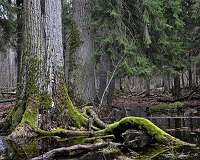
The EU on Thursday took Poland to the bloc's top court over logging in the ancient Bialowieza forest, a UNESCO World Heritage site covering some of Europe's last remaining primeval woodland.
The European Commission, the EU's executive arm, "refers Poland to the Court of Justice of the EU and requests interim measures to stop logging operations in one of Europe's last remaining primeval forests," a statement said.
Bialowieza, straddling Poland's eastern border with Belarus, includes one of the largest surviving parts of the ancient forest that covered the European plain 10,000 years ago.
It also boasts unique plant and animal life, including the continent's largest mammal, the European bison.
The Polish government has said it authorised the logging, which began in May last year, to contain damage caused by a spruce bark beetle infestation and to fight the risk of forest fires.
But scientists, ecologists and the European Union have protested and activists allege the logging is a cover for commercial cutting of protected old-growth forests.
Poland's environment ministry said it was "glad that the case will go to the European Union's Court of Justice" where it will show that the foresting activity "is in line with the law".
Europe's executive branch gave Polish authorities one month rather than the usual two to address its concerns about the forest, citing the "urgency of the situation".
Given the problems, the EU required that Poland implement interim measures immediately, before any court decision.
"The Commission considers the urgency of the situation requires such exceptional measures… irreparable damage is happening as we speak," said European Commission spokesman Enrico Brivio.
Greenpeace called the EU move "a huge defeat of Poland's Minister of Environment Jan Szyszko, who is fully responsible for allowing a three-fold increase" in logging in sensitive areas.
Ancient fungi could help Canada's future northern forests
As Canada's vast boreal and tundra ecosystems experience dramatic warming due to climate change, trees are rapidly spreading north. New research from UBC's Okanagan Campus suggests some of these trees could be getting help from a surprising source: fungi that have lain dormant underground for thousands of years.
"The idea that long-dormant, symbiotic fungi could help trees migrate during p … read more
