
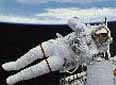
The European Space Agency (ESA) will set up a single European astronaut corps by merging existing national astronaut programmes with the ESA programme. The ESA Council approved this move at its meeting held in Paris last week.
Astronauts from national agencies, such as in France (CNES), Germany
(DLR) and Italy (ASI), will join ESA's astronauts J.F. Clervoy (France),
P. Duque (Spain), C. Fuglesang (Sweden) and C. Nicollier (Switzerland)
to form one corps that will prepare for the mission opportunities
available to ESA as the European partner in the International Space
Station and for missions agreed between the national agencies and the
United States or Russia. Moreover, a number of new astronauts will be
selected from current candidates in order to maintain an appropriate
representation of ESA Member States.
Integration of astronauts from the various national corps into ESA will
begin this year and is to be completed by mid-2000, with a total of 16
active astronauts by that time. After 2000, the normal ESA procedure for
selection will be reinstated, with recruitment occurring about every two
years to make up for normal attrition and enable ESA to continue to
support its planned missions.
All the astronauts will be involved in assembly of the Space Station or
in future operations on board. Their home base will be ESA's European
Astronaut Centre in Cologne, Germany, where all new ESA astronauts will first undergo introductory training. Four of the new ESA astronauts are slated to begin training at NASA's Johnson Space Center in Houston, Texas, by the autumn of this year. The others will remain stationed at the European Astronaut Centre.
The Astronaut Centre will also provide training for all astronauts —
European and from other countries — on the facilities that ESA is
contributing to the Space Station, including the Columbus laboratory,
and a resupply craft called the Automated Transfer Vehicle.
