
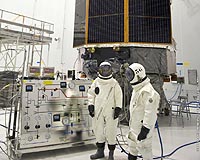
The European Space Agency (ESA) said the launch of two major telescopes designed to probe the origin of galaxies and the aftermath of the "Big Bang" will take place on May 14.
The double launch of the Herschel and Planck telescopes by an Ariane 5 rocket has twice been postponed for ground checks.
"Preparation of the two satellites for launch continues flawlessly at Europe's Spaceport in French Guiana," ESA said in a press release.
The Herschel telescope will collect data on the coldest and most distant objects ever observed to explore the history of how stars and galaxies formed.
Its big feature is a 3.5-metre (11.37-metre) mirror, the largest telescopic reflector ever to be launched in space, and instruments cooled to close to absolute zero.
Planck will examine Cosmic Microwave Background, or residual radiation that washes around the Universe after the "Big Bang" that is believed to have created the Universe some 14 billion years ago.
The goal is to make a fresh estimate of the age of the Universe and see whether it is destined to expand forever or maybe collapse in a putative "Big Crunch".
Planck and Herschel were to have been taken aloft on April 16, but this was postponed to May 6 before being postponed again.
Share This Article With Planet Earth
