
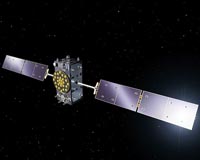
After 17 years, numerous setbacks and three times over budget, Europe's Galileo satnav system went live Thursday, promising to outperform rivals and guarantee regional self-reliance.
Initial services, free to users worldwide, are available only on smartphones and navigation units fitted with Galileo-compatible microchips.
Some devices may need only a software update to start using the service, according to the European Commission, which funds the 10 billion euro ($11 billion) project.
"After years of intense work, we are ready to declare the initial services of Galileo," EU Industry Commissioner Elzbieta Bienkowska announced in Brussels.
"We are joining the closed club of providers of navigation services."
With 18 satellites in place so far, Galileo's signal will be intermittent at first, requiring a boost from satellites in the American GPS system.
But it will grow more reliable and independent over time as orbiters are added to the network circling 23,222 kilometres (14,430 miles) above Earth.
Its proud parents, the commission and European Space Agency, said Galileo should be fully operational by 2020, providing time and positioning data of unprecedented accuracy.
People have become increasingly reliant on geo-localisation for anything from finding bars, pharmacies or the shortest holiday route to tracing parked cars or lost Alzheimer's patients.
Ultimately, Galileo's free Open Service will be able to pinpoint a location to within a metre (just over three feet), compared to several metres for GPS and Russia's GLONASS.
A paying service will provide even more precise data, to within centimetres.
– Strategic priority –
Such precision would be invaluable for safer driverless cars and nuclear power plants, for example.
"When fully operational, Galileo's Search and Rescue service will reduce the time it takes to detect a person lost at sea or in the mountains from three hours to just 10 minutes after a distress beacon is activated," the Galileo website says.
Its signal will eventually reach areas where none is possible today — inside traffic tunnels and on streets where high buildings shield radio waves from satellites flying low on the horizon.
For now, free use is only for owners of two Galileo-compatible cellphones (BQ's Aquaris X5 Plus and Huawei's Mate 9), and about a dozen types of Galileo-ready chips produced by Qualcomm, Broadcom, Intel, Mediatek and u-blox.
A list of Galileo-enabled products can be consulted at www.useGalileo.eu.
"We need the businesses to invest in and innovate with Galileo. To create new applications, new services," said Bienkowska.
The civilian-controlled service is of great strategic importance for Europe, which relies on two military-run services — GPS and GLONASS, which provide no guarantee of uninterrupted service.
Named after Italian astronomer Galileo Galilei, the project was first approved with an initial budget of around three billion euros and plans to be operational by 2008.
It suffered several technical and budgetary setbacks, including the launch of two satellites into the wrong orbit in 2014.
Its total cost until 2020 is now calculated at about 10 billion euros.
The European Commission expects the project will ultimately be an important commercial venture, adding some 90 billion euros to the EU economy in its first 20 years.
Almost 10 percent of Europe's gross domestic product is thought to depend on satellite navigation today — a figure projected to grow to about 30 percent by 2030.
The system's groundbreaking accuracy is the result of the best atomic clocks ever flown for navigation — accurate to one second in three million years.
Galileo will also have stronger signals carrying more information, its makers say.
Galileo: Europe's rival to GPS
Paris (AFP) Dec 15, 2016 –
A snapshot of Europe's Galileo space-based navigation system which went online Thursday, designed to be far more precise than its US military-run rival GPS.
The basics
Now 18-strong, Galileo will ultimately comprise 30 satellites orbiting at an altitude of at 23,222 kilometres (14,430 miles).
Named after Italian astronomer Galileo Galilei, an early celestial navigator, it will be interoperable with GPS and Russia's GLONASS systems, but also able to run independently.
While Galileo is civil-controlled, both GPS and GLONASS are military-run, which means restrictions could be imposed for strategic reasons — as in times of war, for example.
Four more Galileo satellites are set for launch in 2017 and another four in 2018. Galileo should be 100 percent operational by 2020.
Its final four orbiters have yet to be officially ordered by the European Commission, which funds the project.
For the moment Galileo is only usable on smartphones and satnav boxes fitted with compatible microchips.
How it works
Galileo boasts the most accurate atomic clocks, four per satellite, ever used for geolocalisation.
Similar to traditional clocks relying on the tick of a pendulum, atomic clocks also count regular oscillations, in this case switches between energy states of atoms stimulated by heat or light.
Galileo's orbiters are also equipped with powerful transmitters to despatch, at the speed of light, a radiowave containing the exact time and position in Earth's orbit from which it was sent.
The time it takes for the signal to reach a receiver is used to calculate the distance from the satellite.
With several signals at once, the receiver's position can be pinpointed — four beams are required for longitude, latitude, altitude, and local time on Earth.
Accuracy
With geopositioning, a mere billionth-of-a-second clock error can throw a position off by as much as 30 centimetres (12 inches). Galileo will be accurate to one second in three million years.
Once fully deployed, Galileo aims to pinpoint a location on Earth to within a metre — compared to several metres for GPS and GLONASS.
Clients of a paying service can get even more accurate readings — down to centimetres.
Once fully operational, six to eight Galileo satellites will be visible from most positions at a given time, without counting those of GPS or GLONASS.
With so many satellites in orbit, signals will be much improved in cities where tall buildings can obstruct signals from satellites low on Earth's horizon, or in mountainous areas.
What it can do
Apart from satnav, Galileo will offer a search and rescue function as well as an encrypted "Public Regulated Service" for government services such as transport and emergency, law enforcement, border control and "peace missions".
All new cars sold in Europe by 2018 will be fitted with Galileo for navigation and emergency calls.
Its high-precision clocks will boost synchronisation of banking and financial transaction, telecommunications and energy smart-grids, making them more efficient.
It should also boost the safety of driverless cars.
