
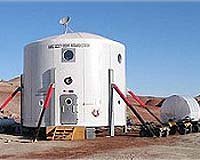
An international team will live in a small shelter in the Utah desert for two weeks this month in a NASA simulation of Martian exploration. The experiment, called Crew 61, is sponsored by the National Aeronautics and Space Administration's Spaceward Bound program and the Mars Society.
The last of the 2006-07 season's missions, the focus of the two weeks will be on emergency preparedness, including simulations and protocol development for extravehicular activity emergencies, radiation poisoning prevention, EVA radiation emergency protocols and an emergency air quantity/location study.
The five crew members from the United States, Peru, Belgium and Spain will live in a two-story, 26.5-foot diameter circular habitat called the Mars Desert Research Station.
"This is a unique mission, the first dedicated to emergency preparedness," said Irene Schneider Puente, a Penn State graduate student in geosciences and a study participant. Schneider will monitor three hypothetical different radiation warning systems during the mission.
Schneider, a native of Madrid, will also serve as the crew physicist, responsible for all Spanish communications and for writing the science mission reports.
