
America's first astronaut, Alan Shepard, took that first suborbital flight of 15 minutes on May 15, 1961. The expected flight time was so short that NASA assumed no toilet facilities would be needed. However, Shepard had to endure several hours in his Mercury capsule before lift-off due to launch delays. You can imagine the results, but it wasn't pretty.
By the time NASA began launching Gemini, astronauts were urinating into relief tubes and the resulting contents were dumped into space. There was a rumor that someone had mounted a placard on the instrument panel with the instruction: "DO NOT FLUSH OVER FREE WRORLD."
By the time the Apollo Lunar Program came about, astronaut conveniences had improved, but fell short of the comforts of home. Neil Armstrong and Buzz Aldrin landed on the lunar surface almost 51 years ago on July 20, 1969 and returned to Earth after a total trip time of 195 hours.
In order to endure the trip without a toilet, lunar astronauts had to urinate into a roll-on cuff and poop into storage bags for later disposal. Many such packages were left on the lunar surface.
Finally, a make-shift toilet was installed on the Skylab space station that was launched in 1973. By the 1980s, a much more sophisticated toilet was installed in the Space Shuttle Orbiter and referred to as the Waste Collection System (WCS). This system employed air flow and rotating fans to distribute solid waste for in-flight storage.
In order to properly use the WCS, astronauts had to endure hours of training. A hose device was used for urination, but for defecation a 4-inch diameter hole in the seat was used. Let's leave the rest to your imagination. Suffice to say that NASA built a simulator with a video camera, while others watched and made jokes.
There are two toilets on the International Space Station (ISS), one each on Zvezda and Tranquility modules. These make use of a fan-driven suction system similar to the WCS. This design has been in use for about two decades.
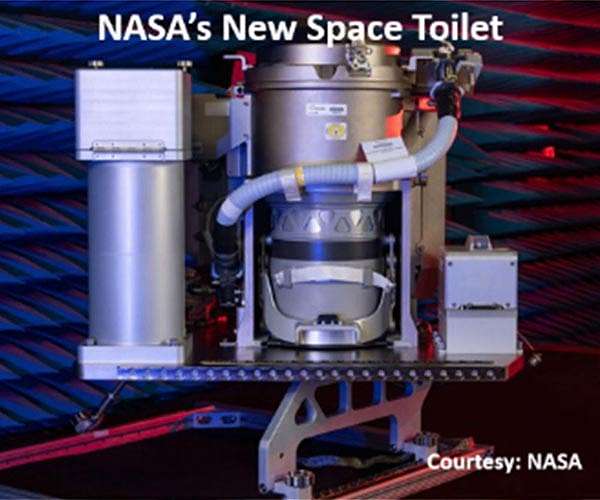
Just last year NASA sent a new $23 million toilet to the ISS, known as the Universal Waste Management System. It took NASA six years to come up with the design for the new, high-tech porta potty. If it performs as expected, a second will travel to the moon as part of NASA's upcoming Artemis 2 mission. If successful the new toilet may be used on future crewed lunar and Mars missions.
