
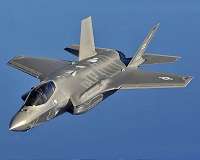
High-level training of U.S. Air Force pilots concluded this week at Red Flag-Alaska, a regular drill which this year featured use of F-35 fighter planes.
The 356th Fighter Squadron and 388th Fighter Wing's F-35A Lightning II planes are the first F-35s to participate in the U.S. Pacific Air Forces-sponsored exercise at Eielson Air Base, Alaska, the Air Force said in a statement on Wednesday.
They were joined by aircraft from the 4th Fighter Squadron of Hill Air Base, Utah, and Joint Base Elmendorf-Richardson, Alaska.
This was the first time F-35s, F-22s and F-16s have worked together in the exercise, officials said.
The two-week drill is one of four in 2020 and formally ends on Friday. Unlike prior Red Flag-Alaska exercises, the fighter wing served as the "blue air," or offensive "home team,"with the presence of the more advanced F-35s.
"The purpose of Red Flag-Alaska is to provide training for the aircrew participating on the blue-air side in order to increase mission readiness and prepare them for combat operations," said Lt.Col. Randolph Kinsey.
A similar exercise is simultaneously underway at Nellis Air Base, Nev.
"The F-35 brings more information to the airspace than we've had in previous generations of aircraft," said Lt. Col. James Christensen of the 356th Fighter Squadron. "This Red Flag is really unique because we now have all fifth-generation fighters on the blue side. When we combine those forces together, we can be more lethal."
Red Flag-Alaska offers realistic combat training for pilots, he added.
A second F-35 squadron will join the 356th Fighter Squadron in Alaska, giving the region a growing presence in the Indo-Pacific area.
"What we need to do in the future and what we have planned for the next Red Flag iteration later this year is we are going to start bringing in partner countries and allies from across INDOPACOM [Indo-Pacific Command]" Christensen said.
"There are F-35s that are going out to Australia, Japan and Korea, and in the future we want to bring those F-35s up here and practice and train, so that we have a standard set of tactics, techniques and procedures," he said.
A previous Red Flag-Alaska exercise in June involved 2,000 personnel and planes from South Korea, Thailand, Japan and the U.S. Air Force.
