
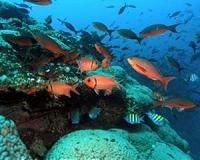
Researchers at Hull University in England recently happened upon a female cichlid "selfing" — having sex with herself.
The fish, a hybrid of two cichlid species that at first appeared normal, had developed male sex organs. It impregnated itself, by ejecting sperm into the water and then sucking it into its mouth where eggs were waiting to be fertilized, producing four offspring. In the year following the remarkable discovery, the fish produced 42 more offspring by selfing.
Cichlid are a family of tropical fish popular in home aquariums.
Selfing is rare in nature, and researchers believe this is the first documented case of the reproductive technique among a species that reproduces normally.
For mangrove killifish, another tropical fish, selfing is a primary reproduction strategy.
"In the mangrove killifish, selfing is an adaptation," Ola Svensson, a biologist at Hull, told Discovery News. "It is believed that it can be hard for them to find a mate, and selfing is better than not producing at all."
Svensson is the lead author of a new paper on the phenomenon, published this week in the journal Royal Society Open Science.
When the specimen finally died, researchers confirmed the fish had both ovaries and testes.
Minimalist cells: Scientists strip genome down to essentials
Rockville, Md. (UPI) Mar 24, 2016 –
Researchers have created a new species of bacteria using the fewest number of genes possible. It turns out the genetic ingredient list for life is longer than scientists thought.
"Our attempt to design and create a new species, while ultimately successful, revealed that 32 percent of the genes essential for life in this cell are of unknown function, and showed that many are highly conserved in numerous species," John Craig Venter, a biotechnologist and founder of the J. Craig Venter Institute, said in a news release.
"All the bioinformatics studies over the past 20 years have underestimated the number of essential genes by focusing only on the known world," Venter said. "This is an important observation that we are carrying forward into the study of the human genome."
Venter is well known as the first scientist to sequence the human genome, but was also the first to transfect a cell with a synthetic genome.
For the latest feat, Venter and his colleagues set out to build a healthy, replicating bacterial cell using the smallest, simplest possible genome. With just 473 genes, their invention — described in the journal Science — is the smallest self-sufficient genetic sequence in the world.
Though the end result of their research — the synthetic bacteria named JCVI-syn.30 — may eventually have real-world applications, Venter said the primary goal from day one has been biological knowledge.
"This paper signifies a major step toward our ability to design and build synthetic organisms from the bottom up with predictable outcomes," JCVI researcher Daniel G. Gibson said. "The tools and knowledge gained from this work will be essential to producing next generation production platforms for a wide range of disciplines."
