
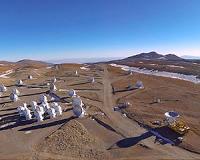
The final antenna for the Atacama Large Millimeter/submillimeter Array (ALMA) project has been taken up to the high-level site at the ALMA Observatory, 5000 metres above sea level. Its arrival completes the complement of 66 ALMA antennas on the Chajnantor Plateau in the Atacama Desert of northern Chile – where they will in future work together as one giant telescope.
The 66th ALMA antenna was transported to the Array Operations Site (AOS) on Friday 13 June 2014. It had been delivered to the ALMA Observatory for final testing in October 2013 (eso1342).
The 12-metre diameter dish is the 25th and final European antenna to be transported up to the Chajnantor Plateau on . It will work alongside its European predecessors, as well as 25 North American 12-metre antennas and 16 East Asian (four 12-metre and twelve 7-metre) antennas.
The global ALMA collaboration is the largest ground-based astronomical project in existence. The final European antenna was manufactured by the European AEM Consortium [1], as part of the largest ESO contract so far covering the design, manufacture, transport and on-site integration of the 25 antennas.
The ALMA Observatory was inaugurated by the President of Chile, Sebastian Pinera, in March 2013. This signified the completion of all of the major systems of the giant telescope and the formal transition from a construction project to a fully-fledged observatory.
"This marks the end point of many years of delivering state-of the art high-technology systems and components to Chajnantor and is an important milestone for the ALMA project. All ALMA antennas are now available to be integrated into the operations," says Wolfgang Wild, the European ALMA Programme Manager.
ALMA probes the Universe using light with millimetre and submillimetre wavelengths, between infrared light and radio waves in the electromagnetic spectrum. Light at these wavelengths originates from vast cold clouds in interstellar space and from some of the earliest and most distant galaxies in the Universe. The telescope will provide astronomers with a window into the mysterious cold Universe where secrets of our cosmic origins are waiting to be discovered.
