
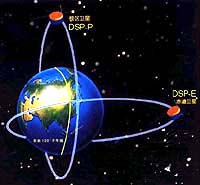
The China-ESA Double Star project is designed to use two spacecraft to study the Earth's magnetosphere, in concert with ESA's four spacecraft Cluster mission. The Double Star spacecraft are known as TC-1 and TC-2, or translating to English, as Explorer-1 and Explorer-2.
Following its successful launch on 29 December 2003 and the commissioning of the spacecraft systems and the instruments, the first Double Star spacecraft (TC-1) was declared ready to start the nominal operation phase by the Commissioning Review Board.
The Board, consisting of members from the Chinese National Space Agency (CNSA) and ESA, reviewed the performance of the spacecraft, instruments and ground segment of the Double Star mission during a meeting held at Villafranca (Spain) on 11 March 2004.
Spacecraft and Instrument Status
The spacecraft and instruments are working nominally and return data as expected in response to Observational Requests.
Ground Segment
The ground segment, which includes the Chinese stations in Beijing and Shanghai and the ESA ground station at Villafranca, has been tested extensively and the downlink performances are better than expected.
The three operation centres, the European Payload Operation System at RAL (UK), the Chinese Double Star Science Operation Centre and Double Star Operation and Management Centre are routinely operating both European and Chinese instruments.
The European Data Disposition System at IWF (Austria) forwards raw data to the European users. Finally the Austrian, Chinese, French and United-Kingdom data centres have successfully exchanged and distributed preliminary science data.
Orbital Information
Double Star currently has its apogee in the solar wind. It typically crosses the magnetosphere, the magnetosheath (shocked solar wind) and the solar wind during a full orbit lasting 27 h.
The effect of ASPOC can clearly be observed in the electron spectrograms (bottom panel) in the diagram below. When ASPOC is activated, between 19:00-00:00 UT and 14:00-19:00 UT, the PEACE sensor measures the full electron spectrum from the surrounding medium, while when ASPOC is off, 01:00-13:00, photoelectrons coming from the spacecraft dominate at low energy (below 10 eV, large red band at the bottom of the plot).
Science Results
