
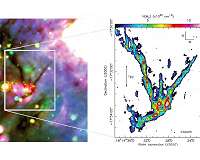
Swirling motions in clouds of cold, dense gas have given, for the first time, an active insight into how gravity creates the compact cores from which stars form in the interstellar medium. The results will be presented, Thursday 6 July, by Gwen Williams at the National Astronomy Meeting at the University of Hull.
Williams, of Cardiff University, explains: "We've known for some time that dusty, filamentary cloud structures are ubiquitous in the Milky Way's interstellar medium. We also know that the densest of these filaments fragment into compact pockets of cold gas that then collapse under their own gravity to form individual stars. However, there's still been a question mark over how, exactly, this happens."
SDC13 is a remarkable cloud network of four filaments converging on a central hub, with a total mass of gas equivalent to a thousand of our Suns. Observations by Williams and colleagues at Cardiff University and the University of Manchester, using the Jansky Very Large Array (JVLA) and the Green Bank Telescope (GBT), have now captured the effects of gravity on ammonia gas moving within the SDC13 system.
Material is pulled from surrounding filaments and accreted onto cores dotted along the cloud structure, converting gravitational potential energy into kinetic energy in the process. Intense surges in the gas motion are observed at two-thirds of the cores that have yet to form stars.
Williams notes: "We believe that the same processes are at work at the filament junction, where both the largest internal motions of the gas and the most massive cores are found. We also speculate that strong acceleration gradients are generated at the hub centre resulting in large accumulation of matter and the formation of massive cores. Hence, our results reveal that this type of interstellar filament and hub system represents a privileged location for the formation of the most massive of stars in the Galaxy."
LISA Gravitational-Wave Observatory Selected as ESA L3 Mission
In a meeting on 20 June 2017 ESA's Science Programme Committee selected the space-based gravitational-wave detector "Laser Interferometer Space Antenna" (LISA) for ESA's third large (L3) mission in the "Cosmic Vision" plan. LISA will consist of three spacecraft separated by millions of kilometers.
They will precisely monitor their relative distance changes with lasers to detect gravitation … read more
