
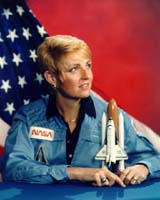
Former U.S. astronaut Millie Hughes-Fulford is designing an experiment to identify which genes in an immune cascade don't turn on in weightless space. Now a researcher at the San Francisco Department of Veterans Affairs Medical Center, Hughes-Fulford will travel Saturday to the Russian Space Agency's launch site at Baikonur, Kazakhstan, to prepare the experiment that was originally destroyed in NASA's Columbia disaster.
Hughes-Fulford, scientific advisor to the VA under secretary, was a payload specialist aboard space shuttle flight STS-40 in 1991.
The human T-cell experiment will be sent to the International Space Station aboard ISS Soyuz 13. That science mission, operated by the European Space Agency, is to launch from Baikonur between Sept. 14-18.
"We're doing this experiment because many astronauts are immunosuppressed during flight. Their T-cells stop working in microgravity," said Hughes-Fulford, who is also an adjunct professor of medicine at the University of California-San Francisco. "This experiment will tell us for the first time exactly which genes involved in the normal immune response aren't activated in space."
