
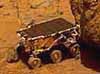
Washington DC – February 12, 1998 – Recent exploration of Mars using small, technologically advanced spacecraft is an example of the budget-conscious missions NASA plans to undertake over the next several decades. The agency is cutting costs and improving mission capabilities by adapting space technologies developed by other government agencies and private industry for communications, data gathering, and other activities.
However, NASA is directing too few resources toward development of
additional critical systems needed for other types of future space
activities, such as studying planets beyond the solar system, says a
new report by a committee of the National Research Council. Although
its resources are limited, the space agency should devote some funds
toward technologies that have the potential to bring many long-term
benefits with a relatively small investment, the report says.
Technologies needed for some possible space activities are unlikely to
be pursued by private industry or other government agencies, because
they offer little immediate financial incentives or will be used only
by NASA.
The committee identified six technological areas for which additional
research and development should be prioritized. Significant advances
could be made in each of these fields with investments of $3 million
to $5 million a year for up to five years.
Tools for mining resources from the moon, Mars, or other planets.
Using resources from space would provide an alternative to launching
supplies from Earth. For example, oxygen extracted from the moon's
surface could be used to make rocket propellant, which could
dramatically cut costs of long-duration missions. Technology
development should focus on extraction, processing, and storage
methods.
High-frequency, wideband interplanetary communications systems.
Sophisticated systems that use microwave or optical transmissions
based on laser technologies — rather than radio frequencies now in
use — would quickly transfer much more data over greater distances.
Robots traveling on other planets could transmit live, high-definition
pictures to Earth. Much of the basic technology already exists, but
more research is needed on reducing weight and power requirements,
improving performance over extremely long distances, and developing
low-cost, Earth- and space-based receivers.
Microelectromechanical systems (MEMS) for space.
Microelectromechanical systems such as microscopic gears, sensors, and
switches already are being used for other purposes. NASA should pursue
MEMS technology for use in spacecraft sensor, communications,
navigation, power, and propulsion systems. These technologies could
eventually be adapted to create miniature spacecraft.
Nuclear power systems. Many deep space missions unable to rely on
solar power could use advanced nuclear reactors. Nuclear power
systems typically are compact, durable, and resistant to space radiation,
dust storms, or other external upsets. Work in this area should focus on
improving energy-conversion efficiency and developing safer nuclear
power sources through new materials and designs.
Radiation-resistant computer memories and electronics. Radiation in
space damages sensitive computers and disrupts signals. To combat this
problem, research should be conducted in lightweight shielding,
protective materials, and data-recovery methods.
Precisely controlled antennas, mirrors, and other space structures.
These types of large, lightweight structures are difficult to control
in weightless space environments. Techniques to measure and control
the exact positions of these instruments will be needed to develop
giant space radars and telescopes for future missions.
In the next three to five years, NASA should reassess whether these
technology areas should continue to be developed or whether other
areas hold more promise, the committee said. In addition, the agency
should ensure that much of the research it funds in these areas be
conducted through private companies and universities.
Report Available
NASA funded the study. Copies of Space Technology for the New
Century are available from the National Academy Press for $15.00
(prepaid) plus shipping charges of $4.00 for the first copy and $.50 for
each additional copy; tel. (202) 334-3313 or 1-800-624-6242. Reporters
may obtain a copy from the Office of News and Public Information
