
While Mars was the star of this year's Lunar and Planetary Science Conference at Houston, other solar system targets got their share of attention.
Among these was Jupiter's volcanic moon Io, thanks to two, mostly-successful, close flybys which the "Galileo" spacecraft made last October and November. The results from the third successful flyby in February were not yet available at the time of the conference.
However, the multiple reports on the latest Io results included few really spectacular revelations which had not already been announced by JPL previously.
Of note though was how "Galileo's" close-up thermal maps made clear — as pointed out by Diana L. Blaney and Rosaly Lopes-Gautier in their reports — was that Io has many more small volcanic eruptions going on than had been thought.
Indeed, Lopes-Gautier reported that "Most dark deposits seen in visual images are sites of thermal emission", and Blaney concluded that the photo it took during the November flyby of a brilliantly glowing curtain of lava spurting upwards from the floor of the Tvashtar caldera may not have been such a long-shot stroke of luck as had been thought:
"The chances of observing some level of active volcanism in any given area [of] at least 135 square km is quite reasonable, and the [February flyby] may well provide us with more high-resolution samples of such phenomena" — especially since during that flyby [unlike the previous two], there were no spacecraft malfunctions that caused Galileo to loose some of its planned photos. One of its upcoming photos, by the way, will be a full-color view of the Tvashtar eruption.
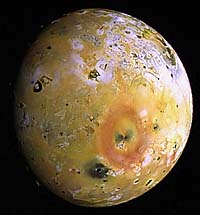
Color is very important in understanding Io's geology, since it is covered with a dazzling multitude of flows and layers of different erupted materials ranging in color from yellow to red to white to black.
Sulfur, by itself, accounts for many of these different shades — and Galileo's photos of the currently-dormant Emakong caldera (some of which were newly released by D.A. Williams during his talk) confirm that the black caldera is surrounded by great yellowish flows which seem to be deposits of pure sulfur.
Paul Geissler reported that active Ionian calderas are surrounded by red deposits which seem to be still-warm sulfur, while Lopes-Gautier said that Galileo had proven that the white areas which coat much of Io — and thought to have been fields of sulfur dioxide snow — are apparently yet another form of sulfur.
