
Efficient conversion of light into electricity is vital for applications in imaging, communication, sensing, and energy. The bulk photovoltaic effect (BPVE) has gained attention for exceeding the Shockley-Queisser efficiency limit seen in traditional p-n junction photovoltaic systems. Van der Waals materials, which possess unique properties such as low dimensionality and strong symmetry breaking, have been found to exhibit notable BPVE traits. However, most BPVE responses in current materials are limited to wavelengths ranging from ultraviolet to visible light, making broader-spectrum applications difficult. This challenge, especially in neuromodulation, has driven researchers to explore alternatives.
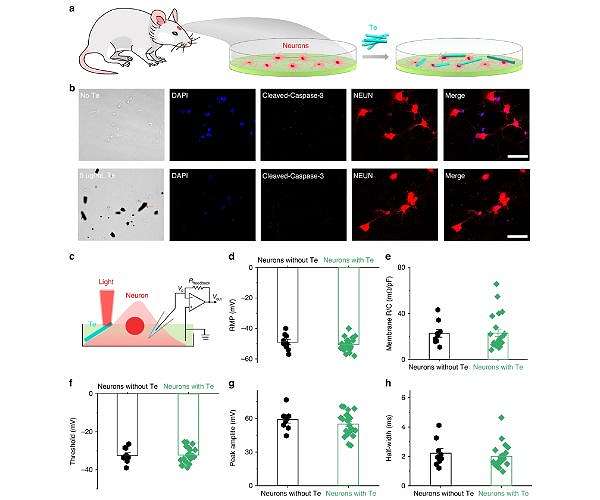
In a new study published in 'Light: Science and Applications', a research team led by Professor Weida Hu from the State Key Laboratory of Infrared Physics at the Shanghai Institute of Technical Physics, Chinese Academy of Sciences, has discovered a significant infrared BPVE in tellurene (Te). This study also demonstrates broad-spectrum neuromodulation using Te nanomaterials, with three key findings: (1) The BPVE-induced photocurrent in Te nanomaterials with adjustable lengths (0.95 um to 12.92 um) is generated at 0 V under uniform illumination; (2) The BPVE in Te covers a wavelength range from ultraviolet (390 nm) to mid-infrared (3.8 um), producing a photocurrent density of 70.4 A/cm, outperforming previous semiconductors and semimetals; (3) The observed BPVE enables Te nanomaterials to trigger action potentials in cortical neurons under broad-spectrum light (637 nm, 940 nm, 1.31 um, 1.55 um), similarly to electrical stimulation.
The researchers highlighted the broader implications of their work, stating: "The giant infrared BPVE of Te and its broad-spectrum neuromodulation demonstrated in this study advance the understanding of BPVE in nanomaterials and their applications. This work provides a novel strategy to enhance the efficiency of narrow-bandgap nanomaterials in converting broadband light into electrical energy via infrared BPVE. It also addresses the major challenges of remote broad-spectrum neuromodulation, particularly in the near-infrared IIa (1.3-1.4 um) region, and further establishes Te with infrared BPVE as a promising candidate for novel nano-modulation with significant potential in neurological disease treatment."
Research Report:Giant infrared bulk photovoltaic effect in tellurene for broad-spectrum neuromodulation
