
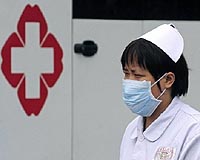
Pregnant women, health workers and people with underlying health problems should receive swine flu vaccines ahead of the rest of the population, EU experts recommended Tuesday.
There was no call for children to be prioritised.
A previous idea to include young people in the list of those to be vaccinated first "was abandoned", an EU source said, without giving a reason.
"All persons from six months old with underlying chronic conditions (e.g. chronic respiratory diseases; chronic cardiovascular diseases and persons with congenital or acquired immunodeficiency)," should be vaccinated first, the experts from the 27 EU nations said in a written statement.
Those with the most severe symptoms should be at the head of the queue, they added.
Pregnant women and "health care workers" were the other two categories prioritised by the European Union Health Security Committee and the Early Warning and Response authorities.
The experts, who thus backed proposals from the European Commission, stressed that "it is the responsibility and mandate of each (EU) member state to develop a vaccination strategy for influenza A(H1N1)", known as swine flu.
"The priority groups identified… are indicative and countries may wish to adapt the prioritisation in line with their epidemiology, health services provisions and resources," the experts agreed.
The approach may also need to be changed "as the pandemic progresses".
EU health experts had already declared that there is no point in pre-emptive school closures or delaying the start of the new term in order to tackle swine flu.
related reports
Italy swine flu vaccinations to begin in November
Italy will begin vaccinations against swine flu in November targeting some 8.5 million people considered at risk to the virus, the health ministry announced on Tuesday.
Those over age 65 with chronic health problems along with medical personnel will be the first to be vaccinated, the ministry said.
Postal and telecommunications employees will also be included, said Giuseppe Mele, an official with the ministry.
"We hope to vaccinate 90 percent of those employees" in the first phase of the vaccination to begin in mid-November, he said.
A second phase will begin in January and will target those aged between two and 27.
Italy's government has announced that it would acquire a total of 48 million doses of the vaccine. The country has a population of some 58 million.
More than 1,500 Italians have contracted the A(H1N1) virus, according to figures provided earlier this week.
According to numbers from Italy's Superior Institute of Health published in July, between three and four million people could contract the virus by March 2010 despite efforts to provide vaccinations.
EU experts recommended on Tuesday that pregnant women, health workers and those with underlying health problems should receive swine flu vaccines ahead of the rest of the population.
Sweden to fund mass swine flu vaccination
The Swedish government has set aside one billion kronor (100 million euros, 142 million dollars) to help pay for the vaccination of its entire population against swine flu, it said Tuesday.
"The government will earmark one billion kronor for the costs incurred by county councils linked to the pandemic," Health Minister Maria Larsson said in a statement.
County councils are in charge of health care in Sweden and will be tasked with carrying out and paying for the mass vaccination.
Sweden has signed an agreement with British pharmaceutical giant GlaxoSmithKline for the delivery of 18 million doses of the vaccine when it is ready, enough to cover its population of some 9.3 million people.
Two doses of the vaccine are needed to ensure protection from the A(H1N1) virus.
Sweden's mass vaccination programme will be on a voluntary basis, though authorities hope to vaccinate as many people as possible. Among those who will be prioritised are those who suffer from respiratory conditions, diabetes, heart conditions and pregnant women.
According to the Swedish Association of Local Authorities and Regions, the total cost of the vaccination programme is expected to be around 2.0 to 2.5 billion kronor, including 1.2 to 1.3 billion for the cost of the vaccine alone.
The association has recommended that the vaccination be offered free of charge to residents of Sweden.
The government hopes to begin vaccinations in late September or early October and complete the procedure by early 2010.
Vaccines against swine flu are not yet available on the market as they are still undergoing clinical trials.
Share This Article With Planet Earth
