
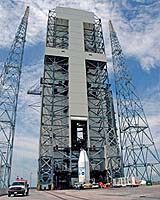
When the National Oceanic and Atmospheric Administration's latest spacecraft, the Geostationary Operational Environmental Satellite-N, launched last month, it carried Goodrich Corp.'s Solar X-ray Imager telescope mirror assembly.
The SXI provides early detection and characterization of solar disturbances, thereby allowing NOAA and the U.S. Air Force to issue space-weather forecasts and alerts to commercial satellite operators.
Solar activity can interfere with space and ground-based communication systems by degrading the performance of navigation tools such as GPS and introducing radiation that can damage space-based electronics and impact the orbit of satellites.
GOES-N is the latest in a series of earth monitoring satellites. It provides continuous monitoring of both earth and space weather events.
Goodrich's Electro-Optical Systems team was responsible for the design, fabrication and verification of five space-qualified telescope mirror assemblies for the SXI program.
The SXI telescope has a wide field-of-view, providing high-resolution imagery over the entire solar disk including the important coronal region. The SXI has super-smooth mirror surfaces fabricated using Goodrich processes originally developed for the Chandra x-ray telescope, allowing the SXI to achieve high contrast imagery across the X-ray portion of the electromagnetic spectrum, where sunspots, solar flares and coronal mass ejections can be observed.
Goodrich's Electro-Optical Systems team, headquartered in Danbury, Conn., has a long history in the design and fabrication of highly complex X-ray telescope systems, including the first space-based imaging X-ray telescope for the Einstein (HEAO-2) observatory and the mirrors for the world's highest resolution, space-based, X-ray telescope, the Chandra X-ray observatory.
