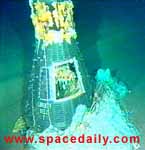
Some 38 years after falling to the bottom of the north Atlantic Ocean, the only U.S. manned spacecraft to be lost at sea was found again. The Project Mercury space capsule named by its pilot Astronaut Gus Grissom the Liberty Bell 7 was found and remotely photographed by a robot submersible under three miles of water Saturday.
But plans to retrieve the capsule were abandoned when the robot, which was to attach cables to the craft and haul it to the surface, sank when its own steel cables were snapped in high seas.
The recovery of the Mercury spacecraft got underway in the evening darkness Saturday as the salvage team led by Curt Newport sent the robot submersible Magellan down to the Atlantic floor to photograph the first of 18 potential targets identified by sideband sonar returns.
To the surprise of Newport and his team, the first of the objects to be photographed turned out to be Grissom's capsule.
The Mercury craft was sitting upright on the ocean floor in relatively good condition, with its name and United States markings clearly visible.
Only the upper portion of the tiny, 8-foot tall craft that had been covered in aluminum was corroded. Its heat shield and landing bag also were not visible to the robot's cameras, which took pictures of the craft for nearly three hours before the cables broke.
Heavy seas in the north Atlantic were blaimed for the cause of the cable's snapping, which sent Magellan to the ocean floor near the capsule.
Newport's team said they hoped to get a second robot submersible and retrieve the Magellan within a few weeks. Once the robot has been recovered, it and the second submersible will be used to try and haul the spacecraft onto the surface of the salvage ship.
The Kansas Cosmosphere and Space Center, Hutchinson, Kansas is set to restore and display Liberty Bell if and when it is retrieved. Liberty Bell 7 with Grissom aboard was launched by a Redstone rocket July 21, 1961 on a 15 minute suborbital spaceflight, the second U.S. manned space mission.
But after splashdown the craft's hatch opened unexpectedly, causing the craft to fill with water. The added weight of the water was too much for the recovery helicopters, which was forced to abandon the craft, which then sank.
The little spaceship has rested on the ocean floor, in the cold dark waters of the north Atlantic, for 38 years until its discovery Saturday. The salvage project is being partially financed by the Discovery Channel cable service.