
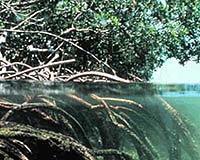
More than half of all mangroves could disappear from some Pacific islands before the end of the century, threatening fisheries and making islands more vulnerable to storms and tsunamis, a UN report said Tuesday.
Rising sea levels associated with climate change, pollution and development are all threatening mangroves — a variety of tree which grows in tidal areas of tropical and sub-tropical regions.
The United Nations Environment Programme (UNEP) study said American Samoa, Fiji, Tuvalu, and Micronesia were expected to suffer the worst loss of mangroves.
"There are many compelling reasons for fighting climate change — the threats to mangroves in the Pacific, and by inference across other low lying parts of the tropics, underline yet another reason to act," Achim Steiner, UNEPs executive director, said in a statement.
Pacific coral atolls, some of which rise about five metres (yards) above sea level, are particularly vulnerable to rising sea levels caused by climate change.
"But there is also an urgent need to help vulnerable communities adapt to the sea level rise which is already under way," Steiner said.
The report recommends reducing pollution to improve the health of existing mangroves, as well as restoring lost or degraded mangrove wetlands.
Mangroves are nurseries for fish, filter coastal pollution and are key sources of timber and construction materials, the report said.
Mangroves are also important to the health of other important ecosystems, including coral reefs and seagrass beds.
They also provide protection against storms and waves. Wave energy may be reduced by 75 percent by going through 200 metres of mangrove forest.
Roughly half the worlds mangrove area has been lost since 1900 as a result of development, with 35 percent of the losses occurring in the past two decades, the report said.
