
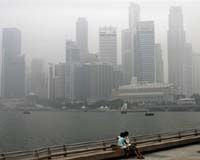
Singapore on Monday maintained a health advisory issued over the weekend as the pollution index soared above the unhealthy range due to smoke from forest fires in neighbouring Indonesia. A foggy haze that shrouded the city-state earlier in the day worsened in the afternoon, and the National Environment Agency put the pollution index at 127 as of 3:00 pm (0700 GMT) — well above the 100 health threshold.
"Persons with existing heart or respiratory ailments should reduce physical exertion and outdoor activity. The general population should reduce vigorous outdoor activity," the National Environment Agency said on its website.
An index of between 101-200 is considered "unhealthy" and can cause mild aggravation of symptoms among those with chronic heart or lung aliments.
It can also cause eye irritation, sneezing or coughing among some unhealthy individuals, the environment agency said.
The smog carries with it a burning smell and has reduced visibility.
Indonesia's annual burn-off to clear land for agriculture causes a haze that typically smothers parts of Malaysia, Singapore and Thailand.
Indonesia itself is also affected and some residents in haze-smothered areas have resorted to praying for rain to alleviate the smog.
Its government has outlawed land-clearing by fire but weak enforcement means the ban is largely ignored.
Indonesian President Susilo Bambang Yudhoyono on Thursday apologised to Singapore and Malaysia over the haze.
A Singapore professor told AFP on Friday the haze from Indonesia could have caused about 50 million dollars in losses to the island-state's economy over the month.
Euston Quah, head of economics at Singapore's Nanyang Technological University, said his estimate was extrapolated from a detailed study he made in 1997, when the annual haze problem was at its worst.
Environment ministers from Singapore, Malaysia and other regional nations affected by the haze met Friday in Indonesia to search for ways of combating the annual problem, which disrupts travel and leads to health problems.
The ministers told their host promptly to ratify a regional treaty on preventing cross-border haze pollution.
