
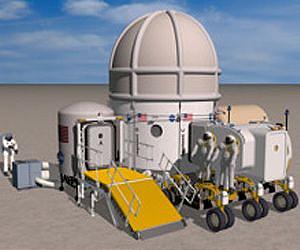
A technique used in NASA's capability-driven architecture analysis is analog field testing in the high desert – an environment which simulates conditions that may be encountered on planetary surfaces in space.
Running through potential "day in the life" scenarios at an outpost with prototype equipment allows designers insight into the utilization of the proposed systems so that they can refine architecture and operations concepts.
A series of Desert Research and Technology Studies (RATS) field tests have been held in locations such as Moses Lake, Wash. and Black Point Lava Flow, Ariz. The September 2009 Desert RATS field test included a 14-day excursion in the desert performed with a Space Exploration Vehicle (SEV).
The 2010 Desert RATS field test was held in Black Point Lava Flow, Ariz., where two Space Exploration Vehicles (SEVs) operated together and docked with a full scale planetary habitat prototype, the Habitat Demonstration Unit (HDU).
New HDU Additions for 2011:
X-Hab Loft
The 2011 mission campaign of Desert RATS is set to be the most extensive DRATS testing to date and involves more systems than in previous years, including more HDU systems. The HDU's core module will include improvements to the 2010 configuration including laboratory equipment and work stations.
However, the 2011 version of the HDU will have an additional system that really stands out: an inflatable second story loft known as the X-Hab. Developed by the winning team in the X-Hab Academic Innovation Challenge, this inflatable second story will provide the astronauts with a means of habitation during the mission.
The HDU configuration for the 2011 Desert RATS field test places the X-Hab loft on the second story of the HDU core module. The loft will contain habitat facilities for crew personnel. The 2011 configuration of the PEM will also include the Hygiene Module and the Extra-Vehicular Activity (EVA) Work Porch. The X-Hab loft with these other new elements result in the new HDU Deep Space Habitat (DSH) configuration.
EVA Work Porch
For this year's Desert Research and Technology Studies (Desert RATS) activities, the Extra-Vehicular Activities (EVA) Porch is being created to provide an EVA operations testing platform for planetary surface or deep space habitats.
The whole subsystem will consist of a main deck, ramp, porch supports, illuminated handrails, and an electric hoist for deployment and stowage. The EVA porch will be installed to the HDU Airlock/Dust Mitigation Module to provide astronauts access to an external work area while providing a safe means for accessing the surface.
Hygiene Module
The Hygiene Module is a new addition to the HDU that will provide the crew with a better means of practicing good hygiene while monitoring water usage rates, hygiene timelines, hygiene logistics of a two-person crew, trash management, and configuration of items that occupy the hygiene module.
The Hygiene Module will consist of a General Hygiene Area (wet-bath area, sink area, supply cabinet, and external hygiene water tank and wastewater tank), a Waste Containment System (toilet), and a Stowage Area.
During the crew's Desert RATS mission, monitoring the use of the Hygiene Module will help the team to understand if the size selected for the module is appropriate, if the methods for collecting and stowing waste and trash are effective, and how much waste (solid and liquid) a two person crew can accumulate over a specified period of time.
HDU Technologies and Features Demonstrated in 2011:
In addition to the the new additions to the HDU, the following technologies and features will be demonstrated in the field during this year's analog testing from the Desert Research and Technology Studies (Desert RATS):
