
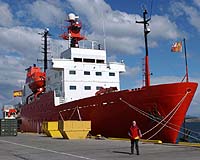
A research team – including a biologist from the University of the Basque Country, is to set sail for the second time on an oceanographic campaign to study the biodiversity of the seas and the ocean floors of the Antarctic.
Bellingshausen Sea
The expedition, aboard the oceanographic vessel, Hesperides, will shortly be working in the Bellingshausen Sea. The reason why these waters have remained almost unexplored is due to its adverse climate which, in turn, has assured that human presence has been scarce.
On this present campaign the scientists will trawl the ocean floor at up to 2000 metres depth, using both Agassiz-trawl fitted with a closed net as well as a Box-corer.
The two methods are complementary. With the Agassiz-trawl a corridor of the sea floor is swept to catch all the species on the way in a mixed form. On the other hand the Box-corer is cast and once it hits the bottom it takes a 50cm x 50cm sample thereof for subsequent analysis on deck. With this sample we can quantify the number of each species per square metre, its biomass, and so on. Thus it is known as a quantified sample of the ocean floor.
When the samples arrive on deck they are washed and classified on board in large groups or rows: sponges, corals, polyquets, molluscs, echinoderms, fish, etc. and are photographed so that their colour when alive and external anatomy can be clearly appreciated. Finally, they are inserted in alcohol or formaldehyde for their subsequent analysis in the laboratory.
Identification of a new species
