
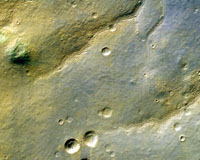
NASA's Mars Reconnaissance Orbiter has returned its first color image of the planet's surface via its onboard High Resolution Imaging Science Experiment.
The powerful camera contains an extra array of light detectors to image in green and near-infrared color bandwidths, which it combines with black-and-white images – via its red-bandwidth detectors – to create color images. The colors are not the same as seen by human eyes, but appear shifted toward the infrared.
NASA mission scientists at Jet Propulsion Laboratory also have processed the image to enhance subtle color variations. The southern half of the scene is brighter and bluer than the northern half, possibly due to early-morning fog in the atmosphere. Large-scale streaks in the northern half are due to the action of wind on surface materials.
The blankets of material ejected from the many small fresh craters generally are brighter and redder than the surrounding surface, but a few are darker and less red. Two greenish spots in the middle right of the scene suggest an unusual chemical composition – which makes them good future targets for the spacecraft's Compact Reconnaissance Imaging Spectrometer for Mars, or CRISM, a mineral-identifying instrument.
In the bottom half of the image, the rough areas display a redder color, indicating wind and sublimation of water or carbon dioxide ice have partially eroded patches of smooth-textured deposits.
The image was taken by HiRISE on March 24 from an altitude of 2,493 kilomters (1,549 miles). The area on Mars is centered at 33.65 degrees south latitude and 305.07 degrees east longitude. North actually is oriented 7 degrees to the left.
At the MRO's distance from the surface, the HiRISE image scale is 2.49 meters (8.17 feet) per pixel, so objects as small as 7.5 meters (24.6 feet) are visible. The image is 49.92 kilometers (31.02 miles) or 20,081 pixels wide and 23.66 kilometers (14.70 miles) or 9,523 pixels long. At the time, the Sun was located 12 degrees above the horizon, and the season for the region is a southern-hemisphere autumn
