
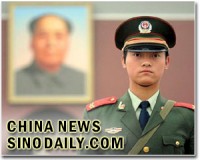
Hong Kong democracy activists have found an unlikely new way to get their message across — using the words of the founder of Communist China, Mao Zedong.
As concern grows that semi-autonomous Hong Kong's freedoms are under threat from Beijing, two large red political banners carrying quotes from Mao that purport to be in favour of democracy have appeared on roadside railings, close to China's liaison office in the city.
Emblazoned in yellow on the banners, the phrases "Abolish one-party dictatorship" and "Exercise democratic politics", are taken from Mao's "Order and Conversation on the Southern Anhui Incident" in 1941, which saw nationalist troops attack communist forces.
Mao used the term "democracy" before he came to power in 1949 as a way to galvanise public support, but on taking the helm installed one-party rule.
Lawmakers in Hong Kong are allocated banner space by lottery for their term and the liaison office spot went to pro-democracy legislator Au Ngok-hin.
The banners were made by Au's campaign coordinator Sam Yip.
"Au and I wanted to remind the officers in the liaison office that this is the way for China to become prosperous and strong, and Mao said so," Yip told AFP.
The banners were also a response to pro-Beijing figures on both sides of the border who have said anyone calling for an end to one-party dictatorship would run the risk of election disqualification, Yip said.
Activists in the city have a history of coming up with inventive ways to promote their views.
Huge pro-democracy banners regularly appear on the city's famous Lion Rock, although they are quickly taken down.
Pro-democracy artists also managed to install a controversial light show on Hong Kong's tallest building two years ago which counted down to 2047 and was swiftly removed.
The year 2047 will be a watershed for Hong Kong as it will see the end of the 50-year agreement signed when Britain returned Hong Kong to China in 1997 and which enshrines the city's freedoms and way of life.
So far the Mao banners, put up on May 10, are still intact and are technically allowed to remain until the end of Au's term in 2020.
Hong Kong's legislature is partially directly elected and its mini-constitution gives rights unknown on the mainland, including freedom of speech.
But the prosecution of pro-democracy activists, the ousting of rebel lawmakers from the legislature and the banning of some opposition candidates from running for office have shrunk the space for political expression.
Fury after Hong Kong journalist attacked in Beijing
Hong Kong (AFP) May 16, 2018 – A Hong Kong journalist was arrested and left injured while trying to interview a human rights lawyer in Beijing Wednesday, the second violent incident against the city's reporters in China within a week.
TV footage showed police bundling cameraman Chui Chun-ming to the ground and dragging him into a van.
Chui, who is from Hong Kong and works for the city's Now TV channel but is based in Beijing, was released hours later after signing a letter of remorse.
Reporters from outside mainland China including those from semi-autonomous Hong Kong are usually given a much freer rein than domestic journalists, who have little opportunity to air their views in a country dominated by state media.
Now TV expressed "extreme anger" over the "unreasonable and violent obstruction during their lawful reporting in Beijing".
The incident came four days after another Hong Kong journalist was kicked and beaten by two men while covering the tenth anniversary of a devastating earthquake in Sichuan.
The men claimed they were "ordinary people" but local residents said they were linked to the government, according to Hong Kong media.
Wednesday's footage showed police obstructing Chui and asking to see his press pass as he attempted to reach a hearing at the Beijing Lawyers Association.
The hearing was to decide whether human rights lawyer Xie Yan-yi, who Chui was trying to interview, should have his licence revoked, according to Now TV.
Xie was one of the lawyers arrested in Beijing's "709 crackdown" of 2015, which marked the largest ever clampdown on the legal profession in China.
When Chui asked police to return his press pass after inspection several officers forced him to the ground, where two plainclothes men pinned his arms behind his back and pushed his head down.
He was then handcuffed and put in the van, with Xie also taken away in a police car.
The Hong Kong Journalists Association urged China to stop "uncivilised acts and suppression" of reporting work. The group handed a joint letter signed by local media to China's liaison office in the city on Wednesday.
The Foreign Correspondents' Club of China also called for "an immediate end to violence against journalists in China".
But Hong Kong officials refused to condemn police actions when pressed by reporters, saying that they needed to "establish the facts".
Chief secretary Matthew Cheung said the Hong Kong government was "very concerned" about the safety of the city's reporters carrying out their duties "anytime, anywhere".
Chui was held for four hours then released to hospital to check injuries to his forehead, wrists and knees.
Now TV said he was requested to sign a letter of remorse to admit that he had displayed a "radical reaction" and was "interfering with a public function" before he was released.
A BBC team was also attacked last year by a large group of men as they tried to interview a Chinese woman petitioning the government.
