
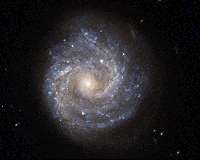
Not all galaxies have the luxury of possessing a simple moniker or quirky nickname. This impressive galaxy imaged by the NASA/ESA Hubble Space Telescope is one of the unlucky ones, and goes by a name that looks more like a password for a computer: 2XMM J143450.5+033843.
Such a name may seem like a random jumble of numbers and letters, but like all galactic epithets it has a distinct meaning. This galaxy, for example, was detected and observed as part of the second X-ray sky survey performed by ESA's XMM-Newton Observatory. Its celestial coordinates form the rest of the bulky name, following the "J": a right ascension value of 14h (hours) 34m (minutes) 50.5s (seconds).
This can be likened to terrestrial longitude. It also has a declination of +03d (degrees) 38m (minutes) 43s (seconds). Declination can be likened to terrestrial latitude. The other fuzzy object in the frame was named in the same way – it is a bright galaxy named 2XMM J143448.3+033749.
2XMM J143450.5+033843 lies nearly 400 million light-years away from Earth. It is a Seyfert galaxy that is dominated by something known as an Active Galactic Nucleus – its core is thought to contain a supermassive black hole that is emitting huge amounts of radiation, pouring energetic X-rays out into the Universe.
Hubble captures massive dead disk galaxy that challenges theories of galaxy evolution
By combining the power of a "natural lens" in space with the capability of NASA's Hubble Space Telescope, astronomers made a surprising discovery – the first example of a compact yet massive, fast-spinning, disk-shaped galaxy that stopped making stars only a few billion years after the big bang.
Finding such a galaxy early in the history of the universe challenges the current understanding … read more
