
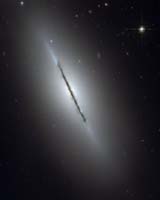
The Hubble Space Telescope captured this unique view of the disk galaxy NGC 5866 tilted nearly edge-on to Earth's line-of-sight. Hubble's sharp vision reveals a crisp dust lane dividing the galaxy into two halves.
The image highlights the galaxy's structure: a subtle, reddish bulge surrounding a bright nucleus, a blue disk of stars running parallel to the dust lane, and a transparent outer halo.
NGC 5866 is a disk galaxy of type S0 (pronounced s-zero). Viewed face on, it would look like a smooth, flat disk with little spiral structure. It remains in the spiral category because of the flatness of the main disk of stars as opposed to the more spherically rotund (or ellipsoidal) class of galaxies called ellipticals.
S0 galaxies, with disks like spirals and large bulges like ellipticals, are called lenticular galaxies. NGC 5866 lies in the Northern constellation Draco, at a distance of 44 million light-years. It has a diameter of roughly 60,000 light-years – only two-thirds the diameter of the Milky Way, although its mass is similar.
Hubble's image of NGC 5866 is a combination of blue, green and red observations taken with the Advanced Camera for Surveys in February 2006.
