
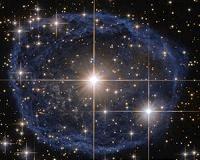
Sparkling at the center of this beautiful NASA/ESA Hubble Space Telescope image is a Wolf-Rayet star known as WR 31a, located about 30,000 light-years away in the constellation of Carina (The Keel).
The distinctive blue bubble appearing to encircle WR 31a is a Wolf-Rayet nebula – an interstellar cloud of dust, hydrogen, helium and other gases.
Created when speedy stellar winds interact with the outer layers of hydrogen ejected by Wolf-Rayet stars, these nebulae are frequently ring-shaped or spherical.
The bubble – estimated to have formed around 20,000 years ago – is expanding at a rate of around 220,000 kilometers (136,700 miles) per hour!
Unfortunately, the lifecycle of a Wolf-Rayet star is only a few hundred thousand years – the blink of an eye in cosmic terms.
Despite beginning life with a mass at least 20 times that of the sun, Wolf-Rayet stars typically lose half their mass in less than 100,000 years. And WR 31a is no exception to this case.
It will, therefore, eventually end its life as a spectacular supernova, and the stellar material expelled from its explosion will later nourish a new generation of stars and planets.
