
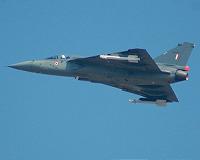
India said Tuesday it had launched air strikes against militant camps in Pakistan's territory, triggering international concern over a dangerous escalation between the nuclear-armed rivals.
Pakistan denied India's claim that the attack had inflicted major damage and casualties on militants responsible for a suicide bombing in Kashmir earlier this month as "reckless and fictitious", and said it would respond in due course.
The attack, if confirmed, would be India's first use of air strikes against Pakistan since 1971 when the two went to war over Bangladesh's independence.
The incursion across the ceasefire line that divides Kashmir came after India threatened retaliation over the February 14 suicide bombing, claimed by the Pakistan-based Jaish-e-Mohammad (JeM) group, that killed 40 Indian troops.
The escalation has triggered international alarm, with China and the European Union calling for both sides to show restraint.
New Delhi said its jets had hit a JeM training camp and killed "a very large number" of militants training to stage suicide attacks in India.
"In the face of imminent danger, a preemptive strike became absolutely necessary," Indian Foreign Secretary Vijay Gokhale said.
Pakistan said it scrambled its fighters to push back the intruders, condemning the "uncalled-for aggression" and denying a militant camp was targeted.
Foreign Minister Shah Mehmood Qureshi said Islamabad would "respond at the time and place of its choosing".
Pakistan military spokesman Major General Asif Ghafoor tweeted that the Indian jets had crossed the Line of Control that divides Indian- and Pakistani-administered Kashmir and that they had merely released a "payload in haste while escaping" near Balakot.
He did not say what was meant by a "payload".
India's foreign ministry also said the camp was at Balakot, but gave no further detail and the exact location remained unclear.
– Residents report blasts –
Balakot is in Pakistan's northwestern Khyber-Pakhtunkhwa province, a few kilometres outside of the portion of Kashmir it controls.
A strike inside undisputed Pakistani territory would be a serious heightening of the bitter rivalry between the two countries.
Residents in Balakot described hearing at least four explosions overnight, but said the damage was minimal.
"There is one house near the place whose wall has collapsed, and one person got minor injuries," said 25-year-old Zubari Afzal.
The Pakistani military escorted journalists to the site where it said the payload had been dropped.
An AFP reporter could see a crater roughly six feet deep and equally wide, and two trees snapped in half, but the only nearby buildings were three mud houses, one with a collapsed wall.
In a separate incident in Pakistani Kashmir, four civilians were killed and ten others injured in cross-border firing Tuesday, officials said.
Indian shelling along the border killed two women and two children in Nakyal sector, local disaster management authority official Shariq Tariq told AFP.
– 'Bleed with 1,000 cuts' –
Indian Prime Minister Narendra Modi and his Pakistan counterpart Imran Khan both summoned emergency meetings of top ministers after the attack.
Khan also convened a meeting for Wednesday of the National Command Authority, which oversees command and control of the country's nuclear arsenal, the military said.
Modi, who is expected to call an election in April, had threatened a "jaw-breaking" response to the February 14 attack.
But at a rally on Tuesday, the Indian leader did not directly mention the strike. He paid tribute to the military and said: "I assure the nation that the country is in safe hands."
Other officials said the strike displayed India's determination to act against Pakistan.
"They say they want India to bleed with a 1,000 cuts. We say that each time you attack us, be certain we will get back at you, harder and stronger," said foreign affairs minister of state, Vijay Kumar Singh, a former head of the Indian army.
While India has consistently accused its neighbour of supporting extremist groups, Pakistan has equally vehemently denied any role in attacks in India and its only Muslim-majority state, Kashmir.
This is the biggest crisis between the neighbours since 2016, when Pakistan-based militants attacked an Indian army camp in Kashmir, killing 19 soldiers.
In response, India launched what it called "surgical strikes" in Pakistani Kashmir. Islamabad denied the strikes ever took place.
Pakistani military analyst Hasan Askari called the latest events "dangerous".
"If such actions continue, it can escalate into major conflict, which will not serve any purpose but to plunge the region into serious crisis," he said.
However, Samir Saran, president of the Observer Research Foundation think tank in New Delhi, said the fact that India remained vague over the exact spot targeted was a sign it did not want an all-out conflict.
"This is to take the pressure off Pakistanis. We are still telling them that we don't want an escalation. Which is why we have said that we have taken a preemptive measure. You don't have to make this into a war, if you don't want to," he said.
Pakistan rejects Indian claim of striking militant camp, inflicting casualties
Islamabad (AFP) Feb 26, 2019 –
Pakistan rejected Tuesday India's claim that it killed many militants in an air strike, branding it "self serving, reckless and fictitious".
Pakistan officials have said that Indian warplanes did breach its airspace and drop a payload over Balakot in the country's northwest, but said there was no damage or casualties.
The National Security Council "strongly rejected (the) Indian claim of targeting an alleged terrorist camp near Balakot and the claim of heavy casualties", Foreign Minister Shah Mehmood Qureshi told a press conference in Islamabad.
"Once again (the) Indian government has resorted to a self serving, reckless and fictitious claim," he said, adding that it had been done for domestic consumption ahead of the Indian general election.
He also called the violation an "uncalled for aggression to which Pakistan shall respond at the time and place of its choosing".
Qureshi spoke after India said Tuesday its warplanes attacked a militant camp where Pakistan-backed fighters were preparing suicide attacks on its cities, sending tensions between the arch-rivals to a new peak.
A "very large number" of militants from the Jaish-e-Mohammad (JeM) group were killed in the night-time attack, according to the foreign ministry.
Pakistan has said its fighters scrambled to force the Indian jets back, and that they dropped payloads as they escaped. It did not clarify what it meant by "payloads".
There have been no reports of any casualties in Pakistan.
The escalation came after a February 14 suicide bombing claimed by JeM that killed 40 troops in Indian Kashmir, setting off a chain of threats and counter-warnings between the nuclear-armed neighbours.
India v Pakistan: a history of conflict over Kashmir
New Delhi (AFP) Feb 26, 2019 –
India and Pakistan have fought two wars and countless skirmishes over Kashmir, the Himalayan region claimed in full by both nuclear-armed rivals.
But rarely have ground troops or air forces crossed the heavily militarised de facto border between the two foes, known as the Line of Control (LoC), in Kashmir.
Here are some of the major clashes between the South Asian enemies over the flashpoint mountainous territory.
– 1947 –
The first war breaks out over Kashmir after partition divides the subcontinent into India and Pakistan. The maharaja of Kashmir, the local ruler, accedes to India as tribal fighters from Pakistan launch attacks.
– 1965 –
India and Pakistan fight a second brief war over Kashmir before a ceasefire is declared.
– 1971 –
India and Pakistan fight another war, not over Kashmir but over Islamabad's rule in then East Pakistan, with New Delhi supporting Bengali nationalists seeking independence for what would become Bangladesh. India's air force conducts bombing raids inside Pakistan.
– 1984 –
Indian forces seize the Siachen Glacier, a remote and uninhabited territory high in the Karakoram Range also claimed by Pakistan. The first of many battles are fought over the high-altitude stretch, until a ceasefire is signed in 2003.
– 1999 –
Pakistan-backed militants cross the disputed Kashmir border, seizing Indian military posts in the icy heights of the Kargil mountains. Indian troops push the intruders back, ending the 10-week Kargil conflict which costs 1,000 lives on both sides.
– 2016 –
India launches what it calls "surgical strikes" on targets in Pakistani Kashmir in September, less than two weeks after a militant attack on an Indian army base leaves 19 soldiers dead. Pakistan denies the strikes took place.
In November, seven Indian soldiers are killed after militants disguised as policemen storm a major army base near the frontier with Pakistan.
– 2019 –
India vows retaliation after at least 40 paramilitaries are killed in a suicide attack in Kashmir territory it controls. New Delhi blames the Pakistan-based militant group Jaish-e-Mohammad (JeM) for the attack. In the early hours of February 26, Indian conducts air strikes against what it calls JeM's "biggest training camp", killing "a very large number" of militants.
