
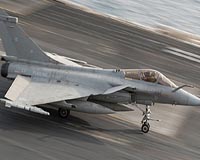
India signed an agreement Friday with France's Dassault Aviation for the acquisition of 36 Rafale fighter jets.
The deal is said to be worth about $8.8 billion and follows years of negotiations.
"I am honored and delighted by the decision of the Indian authorities, which gives new impetus to our partnership for the coming decades, and I thank them for their confidence," said Eric Trappier, Dassault Aviation chairman and chief executive officer.
"Together, Indian and French companies alike, we will endeavor to ensure ambitious industrial cooperation.
"I am certain that the Rafale and its performance will hold high the colors of the Indian Air Force. It will demonstrate unstinting efficiency in protecting the people of India and the sovereignty of the world's largest democracy."
The Rafale is a twin-engine, canard delta wing, multi-role fighter. It has a top speed of 1,188 miles per hour. It has been used by the French armed forces in combat operations for more than a decade.
Deliveries are expected to begin in three years.
India needs more than Rafale to match China: experts
New Delhi (AFP) Sept 22, 2016 – India may have just spent billions of dollars on hi-tech French fighter jets, but experts say it needs to do a lot more if it is going to face up to an increasingly assertive China.
The world's top defence importer has signed several big-ticket deals as part of a $100-billion upgrade since Hindu nationalist Prime Minister Narendra Modi took power in 2014.
But it has been slow to replace its dwindling fleet of Russian MiG-21s — dubbed "Flying Coffins" because of their poor safety record.
An agreement to buy 36 cutting edge Rafale jets from France's Dassault aims to fix that.
"It will give the air force an arrowhead. Our air force has old aircraft, 1970s and 1980s generation aircraft and for the first time in about 25-30 years we will have a quantum jump in technology," defence analyst Gulshan Luthra told AFP.
"Rafale is loaded with (the) best of the technologies and we need it."
The air force says it needs at least 42 squadrons to protect its northern and western borders with Pakistan and China.
It currently has around 32, each comprising 18 aircraft. Air force representatives warned India's parliament last year that the number of squadrons could fall to 25 by 2022, putting India on a par with its nuclear-armed neighbour and arch-rival Pakistan.
– 'Pakistan we can handle' –
But the real concern is China, an ally of Pakistan whose military capacities are way in excess of India's.
"Pakistan we can handle. Pakistan we can muscle our way, but China, no way we can handle," said Luthra. "And if China comes to the aid of Pakistan, then we're stuck."
China and India fought a brief war in 1962, and the border between the neighbours has never been formally demarcated, although they have signed accords to maintain peace.
The Rafale deal, due to be signed in New Delhi on Friday, will supply another two squadrons, although it will be three years before delivery of the jets begins.
It falls way short of previous proposals for India to buy 126 of the jets, which stalled over costs and assembly guarantees.
Currently being used for bombing missions over Syria and Iraq, the Rafale can fly distances of up to 3,800 kilometres (2,360 miles).
Experts say it will allow the air force to strike targets in Pakistan and China from within Indian territory.
But critics argue the Rafale purchase is a costly solution to the problem, even after India bargained hard to get the price down to a reported 7.9 billion euros ($8.8 billion).
– 'Can't afford Mercedes' –
Defence Minister Manohar Parrikar reportedly said last year the larger Rafale deal was too expensive. "We are not buying the rest. I also feel like having a BMW and Mercedes. But I don't because I can't afford it."
Modi has said he wants to end India's status as the world's number one defence importer and to have 70 percent of hardware manufactured domestically by the turn of the decade.
His government lifted a cap on foreign investment in defence to 49 percent last year.
Many now believe India will use the money saved from scrapping the larger Rafale order to invest in its first domestically developed light fighter plane, the Tejas.
The aircraft, touted as the smallest and lightest supersonic fighter aircraft of their class, are designed and manufactured in India, although some components are imported.
Defence analyst Ajai Shukla said the purchase of 36 Rafales would "placate Dassault, the Indian Air Force and public opinion" after the larger deal was scrapped, but did not make good operational sense.
"You don't replace a small, light fighter plane with an extraordinarily expensive heavy monster like Rafale," he said.
