
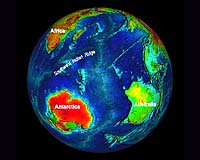
The Indian sub-continent collided with the enormous Eurasian continent 50 million years ago with enough force to create the Himalayan Mountains.
Scientists from the National Geophysical Research Institute in Hyderabad, India, and Germany's National Laboratory for Geosciences determined that with a velocity of about 20 centimeters a year, India was the fastest of the former parts of Gondwanaland.
Until 140 million years ago, India was part of the supercontinent Gondwanaland. When Gondwanaland broke up, its various parts drifted with different velocities. Today those various parts constitute India, Africa, Australia, Antarctica and South America.
While India's lithospheric plate is only about 62 miles thick, the other parts of Gondwanaland are about 125 miles thick.
The scientists posit the reason for the break up of Gondwanaland was a mantle plume that heated the supercontinent from below, thereby causing it to break. That plume, said the scientists, might have melted the lower part of the Indian sub-continent, thus allowing India to move faster and further than the other parts.
The study appears in the Oct. 18 issue of the journal Nature.
