
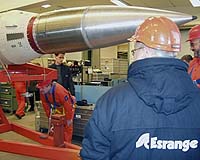
European launchers have come to be associated with French Guiana – powerful large rockets that lift-off from the steamy-hot equatorial base at Kourou.
But ESA also uses much smaller launchers that rise into space from the snow-covered tundra of northern Sweden. EuroNews has covered the most recent launch of one of these Maxus sounding rockets.
"Esrange is today the operational base of the Swedish Space Corporation and it is here that we launch sounding rockets, large stratospheric balloons, that we test new aerospace vehicles and also control satellites in orbit," explained the base's spokeswoman Johanna Bergstrom-Roos.
The region north of the Arctic Circle is an immense snow-scape, where reindeer in the pine forests are practically the sole inhabitants.
"The Kiruna site was chosen for several reasons, one of them being its isolated position. Our rockets can fall back to Earth without any safety problems, with nobody living in the impact areas."
The Maxus rocket is a 12 tonne, slender 15 metre tall vehicle, with a single solid-propulsion stage and an upper section carrying the scientific payload. The rocket is the result of a joint venture between EADS-Space Transportation, Germany, and the Swedish Space Corporation.
With the mission sponsored by ESA, the eight experiments on the Maxus-6 launch relate to, for instance, silicon growth, solidification of aluminium alloys, plant growth, and the physical behaviour of foams ¿ with potential applications in semiconductor production and new materials.
"Gravity on Earth causes all the liquid in foams to flow out and the foam becomes dry very quickly," explained Dominique Langevin, one of the experimenters from the University of Paris-Sud.
"In microgravity conditions, on the contrary, the liquid remains, so one can study what happens when foams contain more liquid. We cannot conduct such experiments in our laboratories on the ground."
The campaign preparing the launch is nearing the final countdown, as ESA's sounding rocket project manager Wolfgang Herfs describes the objectives of the Maxus programme.
"The sounding rockets offer periods of near-weightlessness that range from 3 minutes to 13 minutes. The Maxus-6 launch will provide a long 12.5 minutes of microgravity to a scientific payload of 477 kg."
Nights are long and bitterly cold in Lapland. Temperatures can drop to minus 30 C. In the night, the Aurora Borealis bathes the launch site in an eerie light for the spectacle that is about to take place.
As for every rocket launch, faces are tense as they monitor the consoles. The engineers are anxious to fulfil their contract for the scientists whose experiments are on board.
Launch day
