
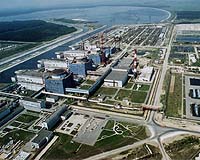
The deputy chief Iran's Organization for Atomic Energy, Mohammad Saeedi, announced on May 30 that Iran intends to build two new nuclear reactors.
AKI news agency reported that Saeedi told journalists, "We want to call an international tender. Both Iranian and international companies will be able to apply in the next two months."
Saeedi provided no further details on where and when the two facilities would be built.
Iran is currently building a nuclear power plant in Bushehr with Russian assistance. Russian specialists began construction of the 1,000-megawatt facility in 1995 under a $1 billion contract with Atomstroieksport.
Under the original 2002 agreement Russia could construct up to five reactors for Iran, including a second one at Bushehr, over the next decade.
Global concern is mounting over Iran's nuclear program. Both the U.S. and Israel insist that Iran is covertly pursuing a nuclear weapons program. Iran insists that its nuclear program is solely for civilian use and has so far refused to give up its nuclear enrichment program, insisting that it is permitted under the nuclear Non-Proliferation Treaty, which Iran has signed.
In January 2005 Iran's nuclear chief, Gholamreza Aghazadeh, said that Iran would open the Bandar Abbas Yellowcake Production Plant for processing uranium ore into uranium "yellowcake" concentrate. The processing is an initial stage, after which the uranium ore concentrate can then be processed into uranium hexafluoride, which later can be turned into a gas used as feedstock for enriching uranium.
United Nations Security Council's permanent members — the United States, Russian Federation, China, Britain and France — along with Germany are currently discussing a package of incentives and penalties to offer Iran in an effort to convince it to halt its nuclear enrichment program.
On Tuesday Iranian Foreign Minister Manuchehr Mottaki expressed "our readiness for a resumption of negotiations" with EU negotiators.
