
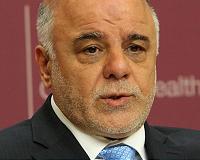
Iraqi Prime Minister Haider al-Abadi on Tuesday gave authorities in Kurdistan 72 hours to give the central government control of airports, a day after the autonomous region voted on independence.
Speaking at a news conference, Abadi said his government would ban "international flights to and from Kurdistan" in three days unless the airports are placed under its control.
Two airports operate in the autonomous Kurdish region of northern Iraq, at regional capital Arbil and in second city Sulaimaniyah.
In addition to national carrier Iraqi Airways, several international airlines from countries such as Germany, Iran, Jordan and Turkey also operate regular flights.
Abadi again stressed that negotiations on the back of the referendum result — expected to be "yes" to independence — were out of the question.
"We will not abandon the unity and sovereignty of Iraq because this is a national duty," he said.
"The government will impose its authority in accordance with the constitution. We remain engaged in talks, but we will not negotiate on the basis of the referendum," Abadi said.
Iraqi troops join Turkish military exercise near border
Silopi, Turkey (AFP) Sept 26, 2017 –
Iraqi soldiers on Tuesday took part in a Turkish military drill close to the Iraqi border on Tuesday, an AFP photographer said, a day after Iraq's Kurdish region held a vote on independence.
Despite warm relations with the Kurdistan Regional Government (KRG), Ankara has been fiercely opposed to the controversial non-binding vote and has threatened to enact a range of options from economic sanctions to military measures against the KRG.
The central Iraqi government in Baghdad has also refused to recognise the referendum.
The Turkish armed forces launched a military exercise with tanks last week in the southern Turkish province of Sirnak as Turkey stepped up its opposition to the poll.
The military continued the drill with reinforcements on Saturday, and said a third phase of the exercises would begin on Tuesday with units of the Iraqi army, who arrived on Monday.
The Turkish military gave no further detail on numbers.
Soldiers could be seen holding Turkish and Iraqi flags while on the move and on tanks during the exercise in the Silopi district, an AFP photographer said.
Turkish President Recep Tayyip Erdogan cautioned the Iraqi Kurdish leader Massud Barzani against pushing for independence after the vote, saying such a move risked sparking an "ethnic war" in the region and said Turkey would consider its options.
"Airspace and ground (options) are all on the table," he said, appearing to refer to previous threats to close the border.
Erdogan on Monday warned the KRG of a cross-border operation by the Turkish army similar to that taken in northern Syria last year against the Islamic State group and Kurdish militants.
Recalling the lighting offensive last August, Erdogan said: "We did this with Euphrates Shield. All the options are on the table right now. In Iraq, when necessary, we will not shy away from taking these types of steps."
Iraq Prime Minister Haider al-Abadi had declared before the vote that he would take "necessary measures" to protect the country's unity.
Iran warns of regional chaos from Iraqi Kurd vote
Tehran (AFP) Sept 26, 2017 –
Iran said Tuesday that the independence vote in Iraqi Kurdistan would trigger "political chaos" in the region, while the Revolutionary Guards said they were sending new missile equipment to the border.
"The outcome of this move is political chaos in the region," said Ali Akbar Velayati, chief foreign policy advisor to Iran's supreme leader.
"The honourable people of Kurdistan will not bear this disgrace," he said, according to the semi-official ISNA news agency.
There was a large turnout for Monday's vote in northern Iraq's autonomous Kurdistan region, which is expected to deliver a resounding "yes" to independence.
As with Turkey, Iran strongly opposes independence for the Iraqi Kurds, fearing it will provoke separatists among its own Kurdish population.
State television made a rare admission on Tuesday that Kurds in Iran's northwestern border region had held peaceful demonstrations in support of the referendum.
"People in the cities of Sanandaj, Baneh and Saghez of Kurdistan province held peaceful gatherings congratulating their Iraqi fellow Kurdish-speaking people," broadcaster IRIB reported.
Iran is also worried about ties between the Kurds and Israel, the only government in the region that has supported Kurdish efforts towards statehood.
"Unfortunately, (Iraqi Kurd leader Massud) Barzani has been connected to the Zionists since long ago and hasn't learned a lesson from Palestine," said Velayati.
Iran has also blamed its traditional enemies — the Americans and British — despite their firm opposition to the referendum.
Meanwhile, the deputy head of the Revolutionary Guards aerial headquarters, Alireza Elahi, said it had "sent new missile equipment to the western region to boost the aerial defence and preparedness against any violation."
At least one Iranian lawmaker called for a more conciliatory stance now that the vote has gone ahead.
"The referendum does not mean independence for Iraqi Kurdistan. There is a process which, if implemented, will take two to three years. So we should not be so sensitive and should only make clear to Kurdish people that this is not in their interest," MP Ali Motahari told reporters, according to ISNA.
Erdogan threatens Iraqi Kurds with border closure, oil block
Turkish President Recep Tayyip Erdogan said on Monday that Ankara would close its border with Iraq's Kurdistan region over an independence referendum and threatened the Iraqi Kurds with blocking their key oil exports.
Despite enjoying strong ties with the Kurdistan Regional Government (KRG), Turkey fears Monday's vote could stoke separatist aspirations among its own Kurdish minority. Erdogan … read more
