
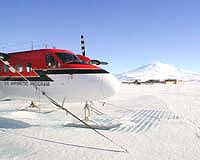
Iridium announced Monday it is providing the New York Air National Guard voice and data satellite communications for its aircraft supporting the National Science Foundation's Operation Deep Freeze research projects in Antarctica.
The NYANG has installed Iridium handsets, as well as communications interfaces from Flightcell, an Iridium value-added manufacturer, on its fleet of ski-equipped C-130 cargo transport aircraft. This will help to ensure reliable communications when flying missions in Antarctica, the company said in a news release.
Flightcell technology enables handsets to be used in the high noise environment inside the aircraft. Calls are connected through to crew members' headsets, leaving their hands free for operational requirements.
The NYANG flies 560 missions per year to provide personnel, food and supplies for the NSF scientists involved in the U.S. Antarctic Program.
"The aircraft operate in one of the world's most difficult and dangerous environments, with extremes of wind and cold, creating special communications challenges," said Major William Smith, the NYANG's deputy Antarctic operations chief.
Smith said frequent solar flares cause magnetic disturbances in the ionosphere, severely degrading HF radio communications. "This means Iridium is often the only reliable communication link, providing an important margin of safety for the aircraft when flying in this region," he added.
Smith called the noise suppression technology supplied by Flightcell "essential for voice communications in the cockpit – without them it is nearly impossible to communicate due to high noise levels."
The portability of the systems is also a plus, he said. "When weather conditions cause us to shut down flight operations, we can easily remove the Iridium phones from the aircraft and use them for communications in the base camp."
The network architecture of Iridium's constellation of satellites in low-Earth orbit intersecting over the poles "provides a robust and reliable solution for communications in Antarctica," said John Wylie, chief executive officer of Flightcell.
"One of the reasons for our success in the aviation sector is the exceptional technical expertise of our value-added partners such as Flightcell," said Don Thoma, Iridium's executive vice president. "Flightcell is a world leader in applying interface technology to allow off-the-shelf satellite communications technology to be used in operational aircraft."
The NYANG is also looking to implement Iridium-based flight-following applications, as well as using the satellite systems to receive regular and automatic Space and Naval Warfare Systems weather reports and warnings.
"Being able to tap the Iridium data communications service will expedite our ability to automate a manual and less efficient data-gathering process," Smith said.
The Antarctic program's facilities include the McMurdo Antarctic Research Station, the Amundsen-Scott South Pole Station and Palmer Station, as well as two research vessels and a fleet of fixed-wing aircraft and helicopters.
The NSF scientists on the ground at the South Pole Station also are using a multi-channel Iridium system to send and receive e-mails.
