
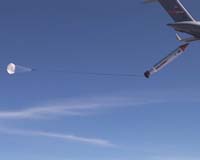
Irvin Aerospace announced Wednesday that its parachute array guided the simulated air launch of a new rocket design that also was the largest payload ever dropped from a U.S. Air Force C-17 cargo aircraft. The QuickReach rocket prototype, which by design did not fire after the drop, weighed 65,000 pounds.
Administered by the U.S. Defense Advanced Research Projects Agency and the Air Force, the drop test was conducted June 14 above Edwards Air Force Base, Calif. It was part of the Falcon Small Launch Vehicle program, in which the military is exploring a way to send small satellites into space cheaply and quickly.
The Falcon SLV program's goal is to develop a vehicle that can launch a 1,000 pound satellite into Low Earth Orbit for less than $5 million within 24 hours' notice.
"This test is made successful in part by dedicated team members like Irvin," said Debra Facktor Lepore, president of AirLaunch LCC, which supervised the experiment. "Their expertise is a valuable asset to this program, on both the Drop Test Article and the QuickReach vehicle."
"We are quite proud that our parachute successfully controlled the pitch attitude of the heaviest single load as it left the unmodified C-17 aircraft," said Tony Taylor, director of space for Irvin Aerospace. He said the company will participate in another drop test later this summer.
Irvin Aerospace designs, develops and manufactures parachutes for space and air vehicle recovery systems, deceleration systems for high-performance aircraft, military personnel parachute systems, cargo parachute systems, ordnance and weapon delivery, spin/stall parachute recovery systems, flare chutes, airbags, simulation, analysis and test. The company was founded in 1919.
