
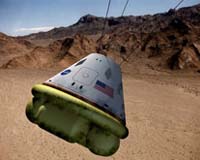
Irvin Aerospace announced Monday it has been awarded a five-year NASA contract to develop an advanced space capsule airbag landing attenuation system for its Crew Exploration Vehicle.
For the NASA project – which will be managed by the agency's Langley Research Center in Hampton, Va., Irvin will utilize a high-speed computer to design and model the capsule airbags while simulating dynamic CEV landings under various loads and conditions.
The computer system uses Fluid Structure Interaction modeling to test and analyze each airbag design concept for precision performance and to reduce development time to meet the CEV project schedule.
Irvin previously has designed and produced deceleration and landing systems for NASA for a variety of missions, including the space shuttle, Pioneer Venus, Surveyor, Huygens and the shuttle's solid rocket boosters.
"Since 2001, Irvin has been focused on the space market working on a series of programs for manned spacecraft," said Tony Taylor, the company's technical director for the space market.
A member of the Airborne Systems Group, Irvin Aerospace is the world's first parachute engineering, design and manufacturing company, founded in 1919.
