
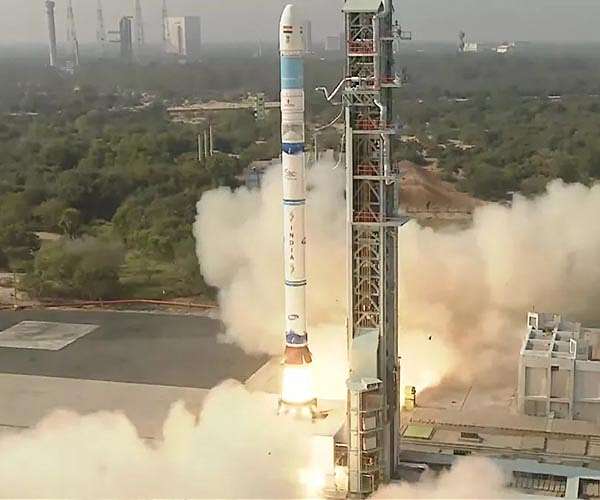
The Small Satellite Launch Vehicle (SSLV) successfully lifted off from the Satish Dhawan Space Centre on the island of Sriharikota, India on Thursday at 9:18 a.m. local time (03:48 UTC), six months after its SSLV-D1 maiden flight in August 2022, which failed to reach a stable orbit.
An analysis "revealed that there was a vibration disturbance for a short duration on the Equipment Bay (EB) deck during the second stage (SS2) separation," ISRO wrote in an update. The SSLV was designed to be a launch-on-demand platform, lower the cost per launch, have the capability of integrating more payloads, low turn-around times, and to only need minimal launch infrastructure.
SSLV-D2 is carrying the Indian Space Research Organisation's (ISRO) EOS-07, Janus-1, and AzaadiSAT-2 into their designated circular low Earth-orbit at 450 km (280 mi) altitude and 37.2 degrees inclination. ISRO's Earth Observing Satellite (EOS) series weighs 344 pounds (156 kg). EOS-07's objective is to collect scientific data for Geographic Information Systems (GIS) applications.
A rare example of an eight-unit (8U) CubeSat with a mass of 19.7 pounds (8.7 kg) AzaadiSAT-2 satellite was on board developed by Space Kidz India, as a test payload. ISRO officials wrote AzaadiSAT-2 "aims to demonstrate LoRa and amateur radio communication capabilities, measure radiation levels in space and demonstrate expandable satellite structure, etc."
Another satellite launched with EOS-07 is a 22.5-pound (10.2 kg) 6U CubeSat, Janus-1, designed and built by the Indian-American company based in California, Antaris. It will serve as a proof-of-concept for the company's software platform.
