
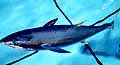
Japan has netted more of a protected type of tuna than allowed, prompting the world's largest tuna-consuming nation to tighten controls on its fishing industry, the farm ministry said Thursday. Southern Bluefin Tuna are protected under guidelines laid down by an international commission after years of heavy fishing, with the worldwide catch limited to 14,080 tons.
Japan is allowed to catch 6,065 tons per year.
But Australia pointed out at the commission's annual meeting in October that as much as 99 percent of the world catch circulated in Japan, farm ministry official Shingo Kurohagi said.
An investigation found that Japan has already exceeded its limit by 1,500 tons in the fiscal year that ends in March, Kurohagi said.
Australia and Japan are often at loggerheads on fishery issues. Australia helped lead opposition to Japanese whalers, who doubled their annual catch in the Antarctic despite environmentalists' concerns that whale populations are threatened.
Southern Bluefin and other types of tuna are often used for sashimi, the popular Japanese dish of raw fish.
The farm ministry requires fishermen to report on their tuna catches and ban further fishing as soon as they reach the limit.
But the government will introduce new rules in April to watch more closely the tuna fishery, Kurohagi said.
"The ministry will allocate the number of catches allowed to each fishing boat and have every tuna tagged with a designated number, so government officials can check each of them at ports," Kurohagi said.
"With the new rules, those who buy and process tunas without the tag also will be punished."
Japan has also said it has suspicions about Australia as the amount of Southern Bluefin Tuna it exports to Japan allegedly exceeds what it catches.
"The fish farmed by Australia become so big to the extent that is impossible biologically, if it is keeping its own limit of tuna catches," Kurohagi said.
The international commission will investigate this issue and report at a meeting scheduled for July, he said.
