
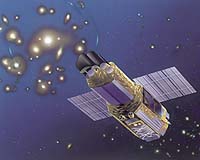
A Japanese rocket blasted off Sunday and successfully launched a satellite that will probe high-energy astronomical phenomena in a 150-million-dollar research project, the space agency said.
A mid-size, solid-fuel M-5 rocket carrying the satellite lifted off from the Kagoshima Space Centre in the southern Japanese town of Uchinoura at 12:30 pm (0330 GMT), the Japan Aerospace Exploration Agency said.
The satellite, code-named Astro-E2, will employ X-ray technology and is designed to "physically investigate high-energy astronomical phenomena, such as black holes and supernovae," the agency said.
The government hailed the initial success of the project.
"We are whole-heartedly pleased as X-ray astronomy is a field in which Japan leads the world," science minister Nariaki Nakayama said in a statement.
Sunday's launch marked the fifth successful blast-off of an M-5. The only failure was the February 2000 mission designed to launch Astro-E2's predecessor.
Japan hopes to put a manned station on the moon in 2025.
