
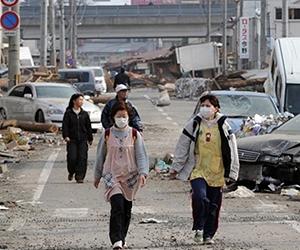
A day after Rikuzentakata mayor Futoshi Toba cremated his wife, he was back at his desk in the devastated city, leading the clean-up after Japan's worst natural disaster in living memory.
When the 9.0-magnitude undersea earthquake hit exactly one month ago, Toba faced an agonising choice — to leave his post and rush home to save his wife from the impending tsunami, or stay and do what he could for the city.
He opted to stay, displaying a commitment to civic duty that has mirrored the stoicism of residents of Rikuzentakata, one of the cities worst affected by the massive earthquake and tsunami of March 11.
An estimated one in 10 of the city's 23,000 residents died as a result of the earthquake, most of them swept away by the massive force of the tsunami that slammed into the city less than an hour later.
Faced with overwhelming odds that meant his efforts to intervene would likely have been futile, Toba made a choice, but he remains tormented by the decision.
His two young children were at school when the tsunami hit, and survived, but his wife, who was in the family's seaside home, was killed.
"When the tsunami came, to be honest I was worried about my wife and children," the 46-year-old mayor told AFP at a makeshift emergency centre that overlooks what is left of his city.
"I thought about jumping into my car and searching for them, but as mayor I forced myself to decide which was more important — doing your duty or saving your family."
Toba, who took over as mayor of Rikuzentakata just a month before the disaster but has worked for the city authority all his life, has won plaudits for his dedication in the face of such unimaginable personal tragedy.
But he has been forced to put his personal grief to one side as he grapples with the enormous impact of the disaster on the city, where dozens of bodies are still being found under the rubble every day.
An estimated 90 percent of the city was destroyed by the tsunami, and the sheer scale of the casualties has made it impossible for authorities even to start thinking about a proper clean-up.
"It's hard to talk about recovery when there are people who are still listed as missing," said Toba, who lost 68 city officials — about a third of the municipal workforce — to the disaster.
The tsunami swept through the lower floors of the city hall, destroying official files and documents, smashing windows and ripping power cables from walls.
Despite the scale of the devastation, Rikuzentakata was the first city to complete temporary rehousing after the quake and has moved 36 families from an emergency shelter set up in the local school to new homes.
But 2,000 new homes are needed, and there are fears people will leave the city rather than waiting for housing.
Japan's prime minister has said the towns along Japan's northeast coast should be rebuilt on higher ground to protect them from future tsunamis, and as Rikuzentakata's residents mourn their dead, many say they will never return.
"Everyone loves this place, it is their home town," said local survivor Ryo Yamazaki, 26, whose mother is among the missing.
"But if it takes 10 or 20 years to rebuild, realistically speaking, people won't wait around. Everyone is worried about that."
Toba also fears his city's plight will be forgotten as media interest in Japan's worst disaster since World War II fades. Already, locals say, the number of journalists coming to the shelter has fallen.
As he focuses on his city's plight, the father-of-two says he has not yet found the courage to tell his children that their mother has been confirmed dead, although he suspects they already fear the worst.
"They know I am busy so they have not brought her up, and I have not been able to bring myself to tell them," he said.
"If I tell them their mother is dead they will want to see the body, and I don't want that to be the image of her that they have in their head."
Even when his wife's body was found, weeks after the disaster, Toba's duties prevented him from rushing to see her.
"I only have regrets in my heart," he said, his voice filled with emotion.
"I ask myself what kind of a human being am I to have allowed that to happen. I have inner battles about it."
Share This Article With Planet Earth
